
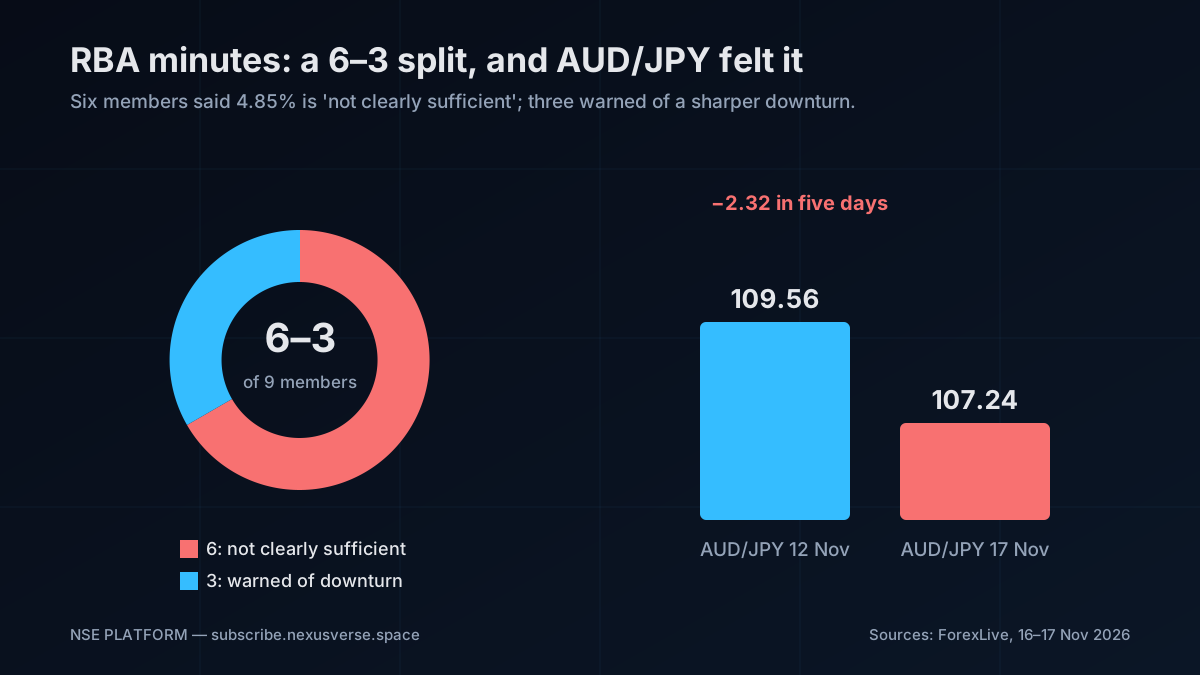
Two central banks, two hawkish surprises, one divergence trade. On Tuesday 17 November 2026, former BOJ Governor Haruhiko Kuroda — the architect of Japan's easing era — said rates may need to rise above neutral if inflation worsens (ForexLive, 04:23 UTC). Hours earlier, the Reserve Bank of Australia's November minutes showed six of nine members judged the 4.85% cash rate "not clearly sufficient", with three warning of a sharper downturn (ForexLive, 04:51 UTC). The market has already voted with its feet: AUD/JPY fell from 109.564 on 12 November to an intraday low of 107.238 on 17 November.
The winning edge in one sentence: this is the only scalper's note this week that trades the BOJ–RBA divergence as a pair — USD/JPY supported by the Fed, AUD/JPY pressured by a peaking RBA and a tightening BOJ — instead of treating two separate headlines as two separate trades.
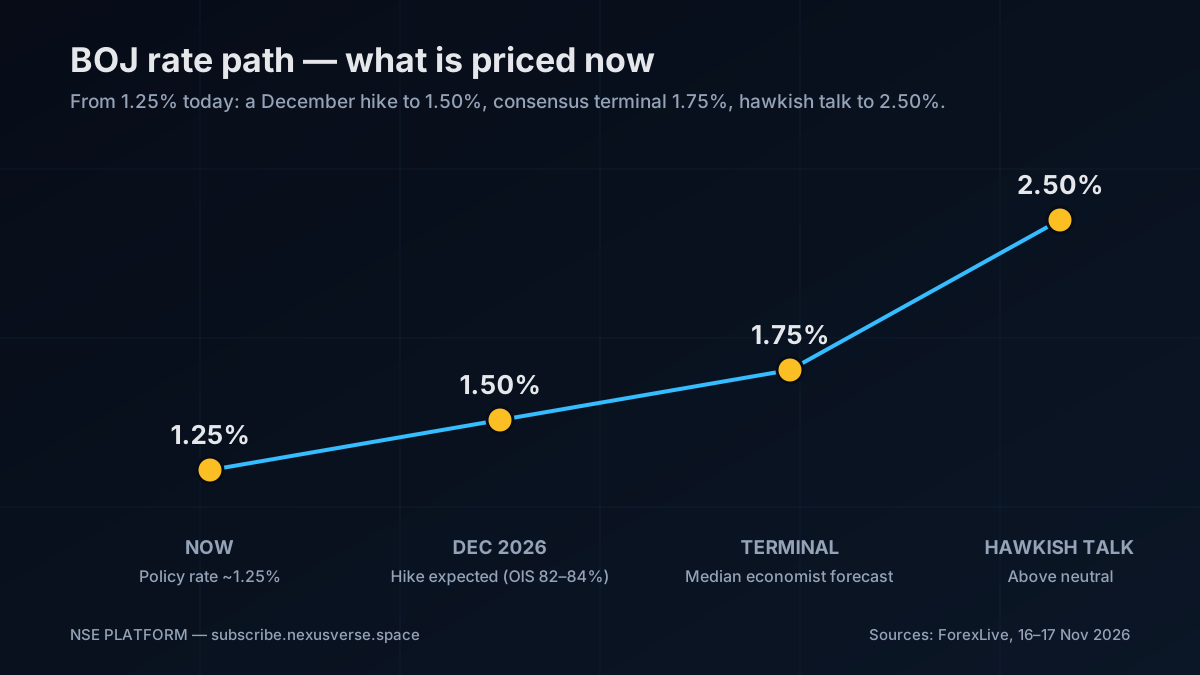
The Bank of Japan is expected to hike to 1.50% in December, with a consensus terminal rate near 1.75% and hawkish talk of 2.50%, while the RBA's 6–3 minutes leave its 4.85% rate looking like a peak. AUD/JPY has already slipped from 109.56 to 107.24. For scalpers, the play is two-way: USD/JPY long on pullbacks toward 160, AUD/JPY short on rallies — and flat through every Aussie data release this week.
What happened: Kuroda, Takata and a 6–3 split
Japan. Kuroda said the outlook depends entirely on inflation: if price pressures become more serious, hikes would naturally have to speed up and could take the policy rate beyond neutral. He blamed imported inflation from the US war with Iran, given Japan's reliance on imported oil, materials and food, and criticised the planned ¥10 trillion food sales tax cut as something that would push up prices, not growth. The BOJ is widely expected to raise rates next month; the median economist forecast sees the policy rate peaking at 1.75%, roughly two more hikes, though some see it reaching as high as 2.5%. The two-year JGB yield sits near 1.88%, and the 10-year near 2.89%.
BOJ board member Hajime Takata reinforced the case on Monday 16 November, calling for relatively swift rate hikes towards the midpoint of the BOJ's estimated neutral-rate range of 1.1%–2.5%, citing a 7.1% year-on-year rise in Japan's October corporate goods price index. The awkward backdrop: Japan's economy shrank 0.1% annualised in Q3, the first fall in four quarters, against expectations of 0.3% growth. Market pricing still favours a December hike, with OIS-derived estimates around 82%–84%.
Australia. The RBA raised its policy rate by 0.25 percentage points to 4.85% on 3 November. The minutes released on 17 November showed most board members judged that rate "not clearly sufficient" to bring inflation back to target, citing rising inflation pressures, strong services inflation and a likely higher neutral rate. Governor Bullock said inflation risks remain skewed to the upside. The RBA projects inflation will exceed the upper end of its 2–3% target range until late 2027, with a return to the 2.5% midpoint only in mid-2028. But the three dissenters warned the economy might be nearing a materially sharper downturn — and that warning sets a high bar for a December move. This week's wage and jobs data, plus the October CPI, are the tests.
The divergence in one table
| Japan (BOJ) | Australia (RBA) | |
|---|---|---|
| Policy rate | ~1.25% | 4.85% |
| Last move | Held (Dec hike expected) | +25 bp on 3 Nov |
| Next meeting | 17–18 December (hike to 1.50% expected) | December (high bar for another move) |
| Terminal view | 1.75% consensus, up to 2.50% talked | 4.85% may be the peak |
| Inflation | Corporate goods prices +7.1% y/y | Above 3% until late 2027 |
| Growth | Q3 GDP −0.1% annualised | Dissenters warn of a sharper downturn |
| The pair | USD/JPY ~159.20, eyes 160 | AUD/JPY 109.56 → 107.24 in five days |
The gap between the two policy rates is still 3.60 percentage points in Australia's favour. But with RBA hike expectations receding while BOJ normalisation proceeds, the gap is narrowing — and a narrowing gap caps AUD/JPY upside. That is the whole trade in one line.
What this means for scalpers
- USD/JPY and AUD/JPY are now opposite trades. The Fed is hiking, the BOJ is hiking, the RBA may be done. USD/JPY stays supported even if the BOJ hikes in December, because the Fed is hiking too; AUD/JPY faces pressure from both sides of its own divergence. Do not trade them with the same bias.
- 160 is the level in USD/JPY. The pair eased to around 159.20 in Asia on Tuesday. A break above 160 with the 2-year JGB still near 1.88% would be a momentum continuation, not a surprise — but it is also the level where intervention chatter historically starts. Size accordingly and do not chase the first print through it.
- Aussie data is the week's landmine. Wage data, jobs data and October CPI all land this week. The minutes make the bar for a December RBA move high, so a soft wage or jobs print hits AUD harder than a hot CPI helps it — the asymmetry favours standing down, not guessing.
- Japan's weak GDP does not cancel the BOJ hike. The economy shrank 0.1% and the market still prices an 82–84% chance of a December hike. Growth data is not the driver here; inflation and the neutral-rate debate are. Do not short yen on the GDP print.
The setup: two pairs, two directions
Use the session logic from our best time to scalp forex — Tokyo open for yen, London overlap for Aussie crosses — with these rules:
- USD/JPY long: on the 5-minute chart, buy pullbacks to the 20 EMA in the Tokyo session (00:00–06:00 UTC) and the London–New York overlap, while the pair holds above 158.50. Stop 12–15 pips below the pullback low. Target 159.80, then 160.00. Take half off at 160.00 — do not hold full size through the level.
- AUD/JPY short: on the 5-minute chart, short rallies to the 20 EMA while the pair holds below 108.00. Stop 12–15 pips above the rally high. Target 107.20, then 106.80. See ATR position sizing for scalping for the division.
- Size: risk 0.25%–0.50% per trade, 2% daily loss limit, pause after 3 consecutive losses. Yen pairs move fast around Tokyo fixing — half size in the first 30 minutes of the session.
- Event gate: no new positions 15 minutes before and after Australian wage data, jobs data, October CPI, or any BOJ speaker. No AUD trades at all on the day of the jobs print unless you have already read it — the minutes say the bar for a December move is high, so a soft print moves AUD more than a hot one.
- Spread filter: USD/JPY spread above 1.5 pips or AUD/JPY above 2 pips in the overlap means the market is still digesting a headline — wait.
- Invalidation: if USD/JPY loses 158.50 on a 1-hour close, the long bias is off; if AUD/JPY reclaims 108.50, the short bias is off. Both levels are the market telling you the divergence read is wrong.
Worked example — not live prices
Example — not live prices. Account $10,000, risk 0.5% = $50 per trade. Short AUD/JPY at 107.80 with a 15-pip stop: 1 pip on 0.10 lot of AUD/JPY is roughly $0.93 (it varies with the AUD/USD rate — check your platform), so a 15-pip stop risks about $14 per 0.10 lot. Position size = $50 ÷ $14 ≈ 0.35 lot. Target 107.20 is a 60-pip move: 0.35 lot × 60 pips × $0.93 ≈ $195 before costs. Spread 1.8 pips on 0.35 lot costs about $6. The example shows why the divergence matters: the 60-pip target exists because the pair already fell 2.32 in five days — you are trading with a move that has already started, not hoping one begins.
When NOT to trade yen or Aussie this week
- AUD pairs on the morning of Australian wage, jobs or CPI data — the asymmetry is against you, and the minutes say the RBA's next move is genuinely uncertain.
- USD/JPY in the first print through 160.00 — let someone else test whether intervention chatter follows; enter on the pullback after, not the breakout candle.
- Yen crosses during a risk-off equity flush — the yen strengthens as a haven and the technical levels stop mattering for a session. This week's chip slump and Nvidia earnings are exactly that risk.
- If you catch yourself trading Kuroda's words instead of the chart — he no longer sets policy. His comment adds weight to the hawkish tail of pricing; it is not a rate decision.
What to watch next
- Australian wage data, jobs data and October CPI, this week — the three prints that decide whether the RBA's 4.85% is a peak or a pause.
- BOJ December meeting, 17–18 December — the hike to 1.50% is 82–84% priced; the surprise would be guidance about the terminal rate.
- USD/JPY 160.00 — the level, the momentum, and the intervention chatter that follows it.
- US retail sales today 13:30 GMT and FOMC minutes Wednesday — both move the dollar leg of USD/JPY; see our US retail sales scalping plan and the hawkish Fed reset.
FAQ
Why is AUD/JPY falling if the RBA just hiked? Because the market thinks the hike was the last one. The minutes split 6–3, the dissenters warned of a sharper downturn, and the bar for a December move is high — while the BOJ is still heading for 1.50% in December. The rate gap is narrowing, and AUD/JPY prices the gap.
Does Japan's shrinking GDP stop the BOJ from hiking? Apparently not. GDP shrank 0.1% annualised and the market still prices an 82–84% chance of a December hike. The BOJ's debate is about inflation and the neutral rate, not this quarter's growth print.
Is 160.00 in USD/JPY a buy or a sell? Neither on the first touch. Take half off longs into it, do not chase a breakout candle through it, and re-enter on a pullback that holds. The level matters because of momentum and intervention chatter, not because the chart says so.
Can I trade AUD/USD instead of AUD/JPY this week? You can, but you are trading two stories at once — the RBA and the Fed. AUD/JPY isolates the BOJ–RBA divergence, which is the cleaner trade this week. If you trade AUD/USD, the dollar's hawkish reset dominates, and the RBA story gets buried.
Sources consulted
- ForexLive / investingLive — "Kuroda, once Japan's great easer, says BOJ rates may need to rise above neutral", 17 Nov 2026, 04:23 UTC. https://investinglive.com/central-banks/kuroda-once-japan-s-great-easer-says-boj-rates-may-need-to-rise-above-neutral/
- ForexLive / investingLive — "investingLive Asia-Pacific market news: RBA minutes lean hawkish", 17 Nov 2026, 04:51 UTC. https://investinglive.com/news/investinglive-asia-pacific-market-news-rba-minutes-lean-hawkish/
- Forex.com — "USD/JPY, AUD/JPY: Central Bank Divergence Creates Two-Way Risk", 16 Nov 2026. https://www.forex.com/en-us/news-and-analysis/usd-jpy-aud-jpy-central-bank-divergence-creates-two-way-risk/?amp=true
- ForexLive — "BOJ's Takata calls for nimble hikes after 1.5% bid, says neutral rate may top estimates", 16 Nov 2026, 04:06 UTC; "Japan economy shrinks 0.1% in Q3, first fall in 4 quarters", 16 Nov 2026, 02:44 UTC; "RBA minutes: 6 members saw rates 'not clearly sufficient', 3 warned of sharper downturn", 17 Nov 2026, 00:36 UTC. (Rows in the site's news database.)
Educational material only — not financial advice. Forex and gold trading with leverage can produce substantial losses. Backtest and demo-trade any setup before risking real capital.