
Every comparison of scalping and day trading ends the same way: it depends on your personality. Scalping suits fast, intense people; day trading suits patient, analytical people. Pick the one that feels like you. That advice is not wrong — it is incomplete. It skips the question that actually decides which style pays: how much does each style cost you per day, and what win rate does your edge need to carry that cost?
This guide answers the cost question first, then the personality question: the daily spread and commission bill for 30 scalps versus 3 day trades, the break-even win rate for each style, a worked example on the same account, and a 3-question test that picks your style from your schedule and execution — not your temperament.
Scalping and day trading both close every position before the day ends, but they charge different prices. A scalper takes dozens of small trades and pays the spread dozens of times; a day trader takes a few larger trades and pays it a few times. The right style is the one whose costs your edge can carry.
Key takeaways
- The difference is frequency, not philosophy: scalpers hold seconds to minutes and take 20–100 trades a day; day traders hold minutes to hours and take 1–10.
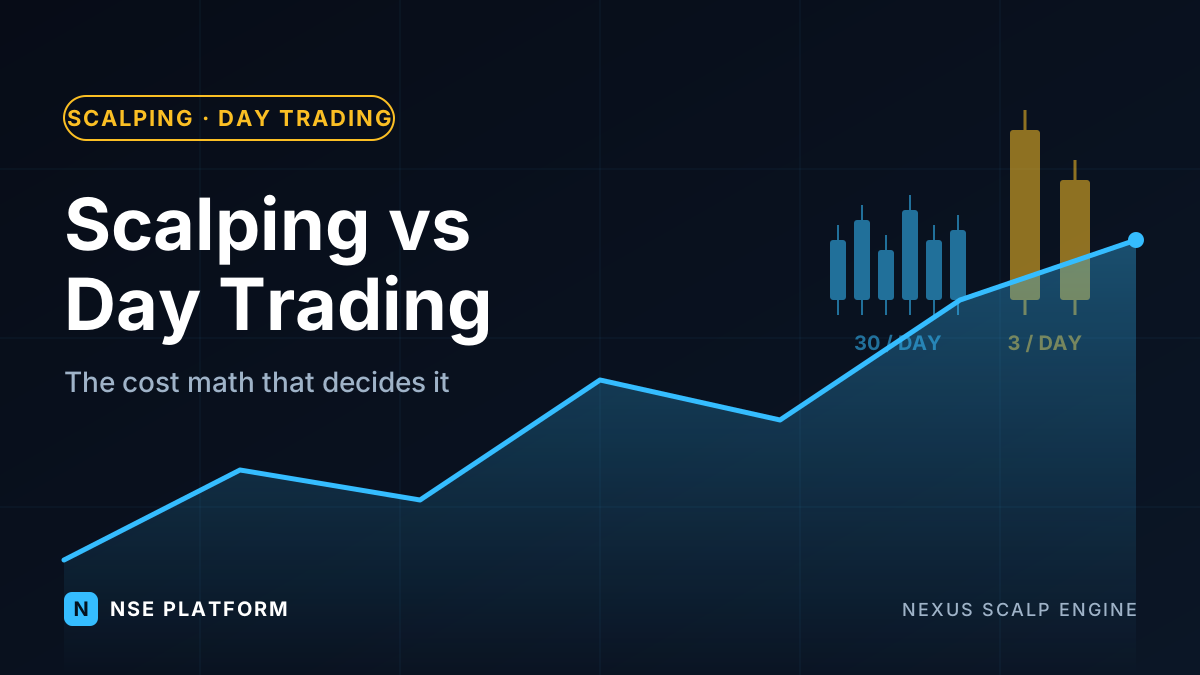
- A scalper pays the spread 30 times a day. A day trader pays it 3 times. On the same account that is $420 a month versus $42 — a 4.2% drag versus 0.42%.
- At 1:1 risk-reward, a scalper needs a 54.4% win rate to break even after costs. A day trader at 1:2 needs 34.3%.
- One popular guide claims scalpers win 60–80% of trades. No source is given, and no trader should plan around a number nobody measured.
- The decision test is three questions: uninterrupted hours, round-trip cost, and tolerance for losing streaks. Answer those before asking about personality.
The comparison table
| Factor | Scalping | Day trading |
|---|---|---|
| Holding period | Seconds to minutes | Minutes to hours |
| Trades per day | 20–100 | 1–10 |
| Typical target | 5–10 pips | 25–75 pips |
| Risk-reward | 1:1 to 1:1.5 | 1:2 to 1:3 |
| Chart timeframes | M1–M5 | M5–H1 |
| Screen time | Near-constant, 6–8 hours | High but interruptible, 2–4 hours |
| Sensitivity to costs | Very high | Moderate |
| Overnight risk | None | None |
| Biggest threat | Costs + overtrading | One bad trade erasing a week |
| Beginner fit | Low — execution first | Medium — planning first |
Both styles close flat before the day ends, so neither carries overnight gap risk. The trade-off is frequency versus size: scalping spreads risk across many small outcomes, day trading concentrates it into a few large ones.
The daily cost bill
This is the part the personality guides skip, and it is the part that decides the comparison. The numbers below are labelled assumptions for a typical ECN-style account on EUR/USD: 0.3 pip spread plus 0.4 pip commission equivalent, a 0.7-pip round-trip cost per trade, and 0.1 lot size ($1 per pip). Check your own costs before trading — the conclusion changes with them.
| Style | Trades/day | Cost/trade | Cost/day | Cost/month (20 days) | Drag on $10,000 |
|---|---|---|---|---|---|
| Scalping | 30 | 0.7 pip | 21 pips ($21) | 420 pips ($420) | 4.2% |
| Day trading | 3 | 0.7 pip | 2.1 pips ($2.10) | 42 pips ($42) | 0.42% |
The scalper pays ten times the day trader's bill for the same market and account. That $420 is the price of frequency, and it comes out of the scalper's edge before a single pip of profit is counted. A scalper who makes 30 pips gross in a day keeps 9; a day trader keeps 27.9.
The bill gets worse on wider spreads. At a 1.5-pip spread plus commission — a 1.9-pip round-trip cost — the scalper pays 57 pips a day, or $1,140 a month on a $10,000 account. That is an 11.4% monthly drag, and no retail edge survives it. The day trader at the same spread pays $11.40 a day and barely notices. This is the first decision rule, and it is not about personality: if your round-trip cost is above 1 pip, scalping is mathematically closed to you. Day trading stays open.
The expectancy table
Costs set the break-even win rate. The table shows what each style needs at its normal risk-reward, after the 0.7-pip round-trip cost. Break-even win rate = net loss ÷ (net win + net loss).
| Style | Stop | Target | R:R | Net win | Net loss | Break-even win rate |
|---|---|---|---|---|---|---|
| Scalping | 8 pips | 8 pips | 1:1 | 7.3 pips | 8.7 pips | 54.4% |
| Scalping | 8 pips | 9.6 pips | 1:1.2 | 8.9 pips | 8.7 pips | 49.4% |
| Scalping, tight | 5 pips | 5 pips | 1:1 | 4.3 pips | 5.7 pips | 57.0% |
| Day trading | 25 pips | 50 pips | 1:2 | 49.3 pips | 25.7 pips | 34.3% |
| Day trading | 25 pips | 75 pips | 1:3 | 74.3 pips | 25.7 pips | 25.7% |
Read the table as a margin of safety. A day trader at 1:2 breaks even at 34.3% — a win rate a disciplined trader can realistically hold, with room to spare. A scalper at 1:1 breaks even at 54.4% — a win rate that demands near-perfect execution, every day, with no slippage surprises. One popular prop-firm guide claims scalpers win 60–80% of trades, with no source and no measurement behind the number. Treat unsourced win rates as marketing: if a 60% win rate at 1:1 were routine, every scalper would be rich, and the cost table above is the reason they are not.
Now put a realistic win rate on each style. These win rates are assumptions for illustration, not measured results — the point is the shape of the math, not the exact numbers.
- Scalper at a 55% win rate, 1:1: expectancy = 0.55 × 7.3 − 0.45 × 8.7 = 4.02 − 3.92 = +0.10 pip per trade. Thirty trades a day gives +3 pips a day. The edge is real and it is razor thin: one slippage event erases it.
- Day trader at a 40% win rate, 1:2: expectancy = 0.40 × 49.3 − 0.60 × 25.7 = 19.72 − 15.42 = +4.30 pips per trade. Three trades a day gives +12.9 pips a day.
Same market, same account, same month. The day trader's expectancy per trade is 43 times the scalper's, because the cost is a rounding error on a 50-pip target and a quarter of the profit on an 8-pip one. That is the whole comparison, and it has nothing to do with personality.
Worked example — the same account, both styles
Example — not live prices. Assumptions are labelled so you can check the arithmetic.
Account: $10,000. Risk per trade: 0.5%, which is $50. Pair: EUR/USD. Pip value: $10 per 1.0 lot, $1 per 0.1 lot.
As a scalper. The setup is the London open breakout from our EURUSD scalping playbook: 8-pip stop, 8-pip target, 1:1. Lot size = dollar risk ÷ (stop distance × pip value) = $50 ÷ (8 × $10) = $50 ÷ $80 = 0.62 lots. Each trade risks $49.60 at 0.62 lots (8 pips × $6.20 per pip). Thirty trades a day means $21 of spread and commission before any profit, and a single 8-pip loss costs $49.60 — more than double the day's gross cost bill.
As a day trader. The setup is a London session trend trade on M15: 25-pip stop, 50-pip target, 1:2. Lot size = $50 ÷ (25 × $10) = 0.2 lots. Each trade risks $50 at 0.2 lots (25 pips × $2 per pip). Three trades a day cost $2.10, and a single loss costs $50 — the same dollar risk as the scalper's trade, but the winner pays $100 instead of $49.60.
The risk per trade is the same either way: about $50. The difference is what a win pays and what the day costs. The scalper needs 30 decisions a day to earn the edge the day trader earns in 3, and every extra decision is another chance to tilt, to chase, to widen a stop. Frequency is paid for in attention, and attention is the scarcest resource in the comparison.
The 3-question decision test
Forget personality quizzes. Answer these three questions in order. The first "no" tells you which style fits.
1. Can you give 3–4 uninterrupted hours inside London or New York? Scalping needs near-constant attention — realistically no fewer than 3 focused hours to make the frequency pay. Day trading needs 2–4 hours, and the hours can be split around setups. If you cannot watch the market live during the session, both intraday styles are out and swing trading is the answer.
2. Is your round-trip cost 0.7 pip or less on EUR/USD? Check your spread plus commission right now. Above 1 pip, scalping is closed — the break-even win rate passes 57% and the monthly drag passes 11%. Day trading stays open up to a much wider spread, because the cost is a small fraction of a 50-pip target.
3. Can you take 10 losses in a row without changing the plan? A scalper at 55% loses 10 in a row regularly — it is arithmetic, not bad luck. A day trader at 40% loses 3 in a row regularly, and each loss is a bigger dollar amount. Which losing streak breaks you? The style whose losing streak you can sit through is the style you can execute. The one whose streak makes you widen stops or double size is the one that will empty the account.
If you pass all three, scalping is viable for you — and only then does personality matter. If you fail question 1 or 2, day trading is the answer regardless of temperament. If you fail question 3 for both, the answer is neither: paper-trade until the streaks stop hurting.
When to switch styles
- Switch to day trading when your costs rise, when your schedule shrinks, or when you catch yourself taking trades to fill time rather than to follow a setup. Overtrading is a scalping disease; day trading is the treatment.
- Switch to scalping when your execution is consistently clean, your costs are verified low, and you find day trading boring in a way that makes you force trades. Boredom is a day-trading disease; scalping is not the treatment — discipline is. Only switch when the cost table says the switch pays.
- Do both, separately. Many traders scalp the London open and day-trade New York. That works only if each style keeps its own rules, risk, and journal. Mixing them mid-trade — turning a scalp into a day trade because it is losing — is how both styles fail at once.
Five mistakes and the fixes
- Choosing by personality alone. Fix: run the cost table first. Personality picks the style you enjoy; costs pick the style that pays.
- Believing unsourced win rates. Fix: any win-rate claim without a sample size and a measurement window is marketing. Plan on the break-even rate, not the advertised one.
- Scalping on a wide spread. Fix: measure your round-trip cost. Above 1 pip, scalping is closed — switch styles instead of switching brokers every month.
- Turning scalps into day trades. Fix: the stop and target are set before entry. A scalp that runs past its target is not a day trade; it is a broken rule.
- Counting trades instead of expectancy. Fix: thirty trades at +0.10 pip expectancy earn less than three trades at +4.30. Frequency is not profit.
Frequently asked questions
What is the difference between scalping and day trading?
The difference is holding time and frequency. Scalping holds positions for seconds to minutes and takes dozens to hundreds of trades a day, targeting a few pips each. Day trading holds positions for minutes to hours and takes a handful of trades, targeting larger intraday moves. Both close every position before the day ends, so neither carries overnight risk.
Is scalping better than day trading?
Neither is inherently better. Scalping pays only when your round-trip cost is low (0.7 pip or less on EUR/USD) and your win rate clears 54.4% at 1:1 after costs. Day trading pays at a 34.3% win rate at 1:2 — a much wider margin of safety. The right choice depends on your schedule, your costs, and which losing streak you can sit through.
Is scalping harder than day trading?
Yes, for most traders. Scalping demands faster execution, sharper focus, and tighter cost control, and the break-even win rate is far higher — 54.4% versus 34.3% at standard risk-reward. Day trading allows more time to plan and manage each position, and a single win pays for two losses. The difficulty gap is the cost gap.
Which is better for beginners, scalping or day trading?
Day trading is usually better for beginners. Its slower pace gives new traders time to analyse setups, place stops, and manage risk, and the cost table is forgiving: a 1-pip spread barely dents a 50-pip target. Beginners should build discipline with day trading first and only explore scalping once their execution and risk habits are consistent — and only after verifying their costs.
Can you do both scalping and day trading?
Yes, many traders use both, applying scalping in fast, liquid sessions and day trading when setups need more time. The key is to keep each style's rules, risk, and journal separate. Switching styles mid-trade — usually by turning a losing scalp into a day trade — undermines both.
How much money do you need to start scalping?
The capital question is really a cost question. On a $10,000 account, a scalper pays about $420 a month in spread and commission at 30 trades a day — a 4.2% drag before profit, against $42 for a day trader. The smaller the account, the more the scalper's fixed cost bill matters. Start with the style whose monthly cost your account can carry.
Related reading
- Forex Scalping for Beginners: One Simple M5 System, Cost Math First — the beginner system this comparison assumes you already understand.
- 1-Minute vs 5-Minute Scalping: Which Timeframe Pays After Costs? — the same cost logic applied inside scalping itself.
- ATR Position Sizing for Scalping — how to size both styles from fixed dollar risk.
- EURUSD Scalping Strategy: The London Open Playbook — the scalping setup used in the worked example.
Sources consulted
- Scalping vs day trading: which style fits you? — ThinkCapital
- Scalping vs day trading for prop firms — Deal Prop Firm
- Scalping vs day trading vs swing: how to choose — SnappChart
Educational material only — not financial advice. Forex and gold trading with leverage can produce substantial losses. Backtest and demo-trade any setup before risking real capital.