
Not every market move is a trading opportunity. This weekend, Bitcoin fell to a four-month low near $62,000 as crypto liquidations topped $2 billion, and Brent crude faces a two-million-barrel-a-day surplus in 2027 according to Goldman Sachs. Both stories matter for forex scalpers — not because you should trade Bitcoin or oil, but because the same forces are moving your pairs: a hawkish Fed repricing, an AI-stock slump, and a war premium that is fading from oil while it still lifts inflation expectations.
The winning edge in one sentence: this is the week's risk filter — the two numbers that tell you when to shrink size and when to stand down entirely, instead of a fourth article pretending every headline is a setup.
Bitcoin fell to a four-month low near $62,000 over the weekend as crypto liquidations topped $2 billion, then recovered to about $64,910. Brent crude held near $95 on Monday while Goldman Sachs forecast a two-million-barrel-a-day surplus in 2027, with Brent easing to $78 by year-end. For forex scalpers, the message is a filter, not a trade: shrink size when liquidations spike, stand down through Nvidia earnings, and never let a crypto flush set your forex bias.
What happened: the flush and the surplus
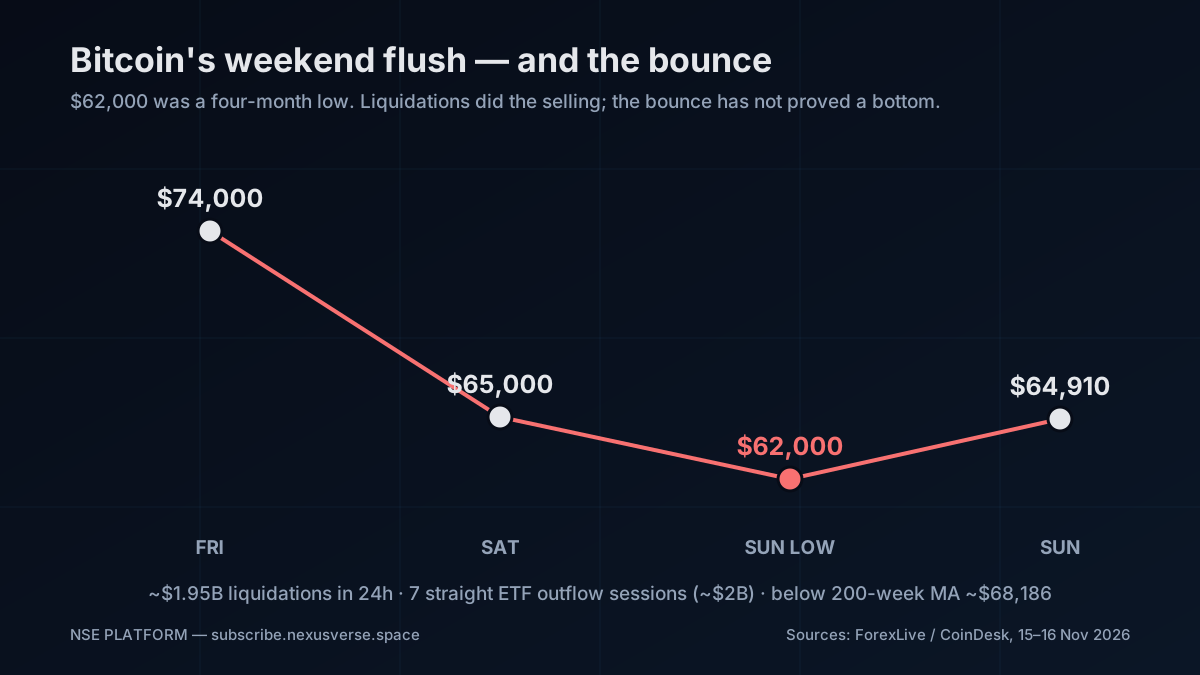
Bitcoin. The weekend flush removed much of the leveraged long exposure that had built up before the drop, with about $1.95 billion in crypto liquidations in 24 hours — roughly $600 million of it in Bitcoin longs. Bitcoin touched a four-month low near $62,000, its lowest since July, then recovered to about $64,910 late on Sunday. It is still down about 14.2% on the week. US spot Bitcoin ETFs recorded seven consecutive sessions of net outflows, nearly $2 billion pulled in total. Several drivers are in play at once: ETF redemptions, rate-hike expectations, and lingering exchange-security worries after the Binance hack. Bitcoin is also trading below its 200-week moving average near $68,186, with daily RSI at 20.
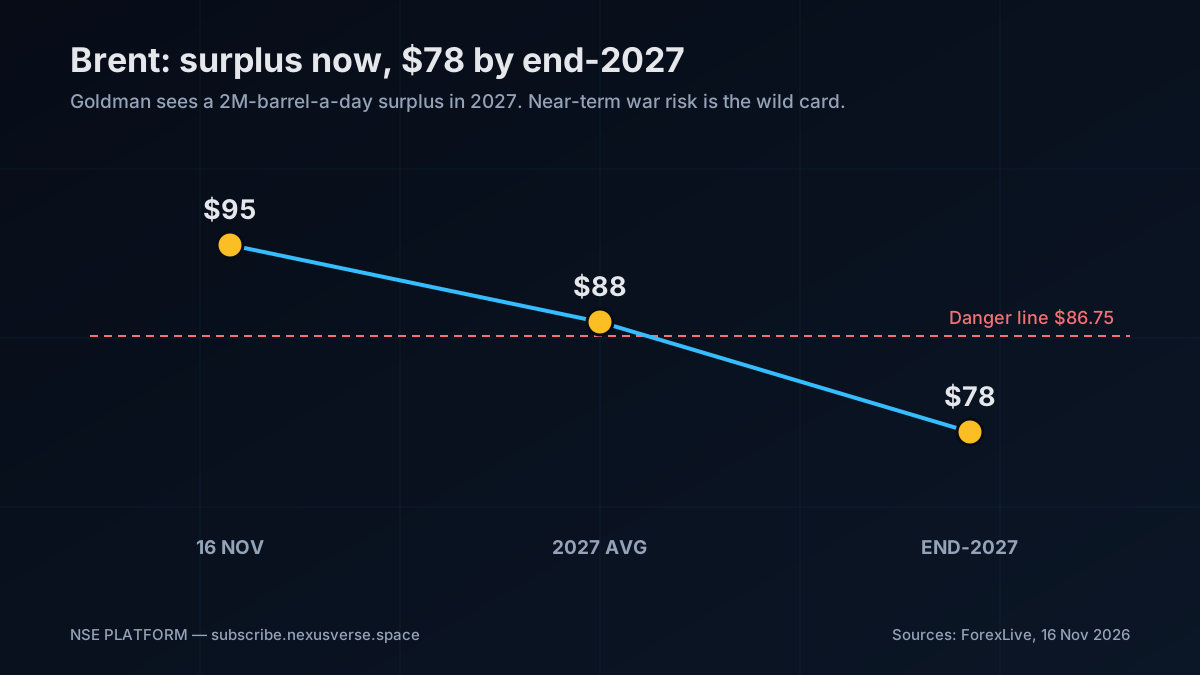
Oil. The International Energy Agency flipped its fourth-quarter outlook from a supply deficit to a supply surplus, and Brent fell on the news. Goldman Sachs expects crude production to outstrip end-use demand by two million barrels a day in 2027, with Brent forecast to average about $88 before easing to $78 by year-end. Near term, the market is still driven by the war: confirmation of the IRGC's tanker-sinking claims could quickly rebuild the risk premium Goldman expects to fade. One oil analysis in the news flow puts $86.75 as the danger line for the current price structure. Brent held near $95.40 in Asia on Monday, with WTI around $87.10.
The connective tissue. Morgan Stanley's 2027 outlook sits on the other side of the same week: maximum overweight global stocks, an 8,700 S&P 500 target, 15% upside on AI capital spending — while chip stocks slumped again ahead of Nvidia's first post-Huang earnings report. The market is not deciding whether AI spending is real; it is deciding what it is worth while rates rise. That indecision is what makes this a risk-off week rather than a directional one.
What this means for scalpers
- Liquidation spikes are a size signal, not a buy signal. The flush removed leveraged longs, which lowers the risk of another forced-selling cascade in the near term — but it does not bring in new buyers by itself. Sentiment is fragile. When you see a $2 billion liquidation print, the correct forex response is smaller size, not a contrarian long.
- Oil's surplus is disinflationary; the war premium is inflationary. Both forces are live at once. The surplus pulls Brent toward $78 over the year; a Hormuz incident rebuilds the premium in an afternoon. That is why oil-linked pairs (USDCAD, NOK crosses) can reverse without warning this week — trade them with half size and a news gate.
- The Fed repricing is the common driver. The same hawkish Waller speech that floated a 50 basis point December hike tightened financial conditions across crypto, equities and gold. If you are trading EURUSD, XAUUSD and Bitcoin-adjacent sentiment as three separate stories, you are triple-counting one driver. Our hawkish Fed reset covers the rate path in full.
- Nvidia earnings are the week's binary for risk. Chip stocks have slumped into the report, and the AI trade is now a macro trade. A bad print extends the risk-off move into every pair you trade; a good one unwinds it just as fast. No forex scalp is worth holding through that release.
The setup: the risk filter (not a trade)
This article deliberately has no entry setup — there is no clean setup in a liquidation flush, and inventing one would be the exact mistake the quality gate exists to prevent. Instead, here is the filter to apply to the setups you already have, from our scalping strategy hub and gold levels playbook:
- Size rule: when any 24-hour liquidation print exceeds $1.5 billion, cut position size in half across all pairs for the next session. The flush tells you leverage is being removed; it does not tell you where the bottom is.
- Correlation rule: if Bitcoin is down more than 5% on the day, do not take counter-trend longs in risk pairs (AUDUSD, NZDUSD, GBPUSD). The same risk-off flow hits them, and the technical setup will fail for a macro reason.
- Oil rule: no USDCAD trades within 30 minutes of an Iran/Hormuz headline. The premium rebuilds faster than any spread filter can protect you.
- Earnings gate: no new positions 30 minutes before and after Nvidia's earnings release. The AI trade is a macro trade this week, and the release moves everything.
- Daily stop: tighten the daily loss limit to 1.5% (from the usual 2%) for the rest of this week. Risk-off weeks punish revenge trading hardest, because the moves are fast and the reversals are faster.
- Re-entry test: normal size returns only when two conditions hold together — Bitcoin holds above $62,000 for a full session AND the 2-year yield stops making new highs. One without the other is not a recovery.
Worked example — not live prices
Example — not live prices. Account $10,000, normal risk 0.5% = $50 per trade. The liquidation filter is active after the $1.95 billion weekend print, so risk is halved to 0.25% = $25 per trade. Short EURUSD at 1.0850 with a 10-pip stop: 1 pip on 0.10 lot is $1, so a 10-pip stop risks $10 per 0.10 lot. Position size = $25 ÷ $10 = 0.25 lot. Target 20 pips: 0.25 lot × 20 pips × $1 = $50 before costs. The example shows what the filter costs you on a winner ($50 instead of $100) — and what it saves you on the loser that follows a liquidation cascade, which is the trade that ends weeks.
When NOT to trade at all this week
- Through Nvidia's earnings release — the binary that moves every risk pair at once.
- In the 30 minutes after any Hormuz headline — the oil premium rebuilds faster than spreads normalise.
- Counter-trend longs in AUDUSD or NZDUSD while Bitcoin is down more than 5% on the day.
- Any "buy the dip" in gold justified by the Morgan Stanley $5,250 target — the target is for Q4 2027, and gold's driver this week is the Fed, not the forecast.
- If you have already hit the tightened 1.5% daily loss limit — the week is risk-off, and tomorrow's session will still be there.
What to watch next
- Nvidia earnings — the release that decides whether the AI slump extends or unwinds.
- Bitcoin $62,000 — a full session holding above it is the first half of the re-entry test; a break below it with fresh liquidations extends the flush.
- Brent $86.75 — the danger line in the current price structure; a break below it confirms the surplus story is winning over the war premium.
- US retail sales today 13:30 GMT and FOMC minutes Wednesday — both move the dollar leg of every pair; see the retail sales plan and the Fed reset.
- ETF flows — seven straight outflow sessions is the trend; the first inflow session is the signal that crypto selling pressure is easing.
FAQ
Should I buy Bitcoin at $62,000? This site does not trade crypto and this article is not a buy call. What the news says: the flush removed leveraged longs, which lowers near-term cascade risk, but it does not bring in new buyers by itself. The re-entry test in this article — hold $62,000 for a full session and the 2-year yield stops making new highs — is the filter, not a prediction.
Why does Bitcoin matter for my EURUSD scalps? Because the same driver moves both: the hawkish Fed repricing tightened financial conditions across crypto, equities and gold at once. When Bitcoin prints a $2 billion liquidation day, the risk-off flow is already in your forex pairs. The size filter exists for that reason.
Is oil going to $78? Goldman forecasts Brent easing to $78 by end-2027 on a two-million-barrel-a-day surplus. That is a forecast for next year, not a price for this week — and the same forecast flags near-term upside risk from attacks on shipping. Trade the $86.75 danger line this week, not the $78 target.
What if Nvidia beats earnings? Then the risk-off move likely unwinds fast, and the filter lifts: normal size returns when Bitcoin holds $62,000 and the 2-year yield stops making new highs. Do not pre-position for the beat — the release is a binary, and binaries are not scalps.
Sources consulted
- ForexLive / investingLive — "Weekend - Bitcoin fell to four-month low near $62,000 as crypto liquidations top $2 billion", 16 Nov 2026, 01:49 UTC; "Goldman sees Brent at $78 by end-2027 as oil surplus returns, flags near-term upside risk", 16 Nov 2026, 03:47 UTC; "Oil price analysis: Sellers are losing momentum, but $86.75 remains the danger line", 16 Nov 2026, 01:51 UTC. (Rows in the site's news database.)
- ForexLive / investingLive — "investingLive Asia-Pacific market news: Chipmakers hit ahead of Nvidia", 16 Nov 2026, 04:34 UTC. https://investinglive.com/news/investinglive-asia-pacific-market-news-chipmakers-hit-ahead-of-nvidia/
- TigersPost — "Daily Bitcoin Analysis: Spot ETF Outflows & Extreme Fear (Nov 16, 2026)". https://tigerspost.com/2026-11-16-bitcoin-analysis-outflow-liquidation-etf/
Educational material only — not financial advice. Forex and gold trading with leverage can produce substantial losses. Backtest and demo-trade any setup before risking real capital.