
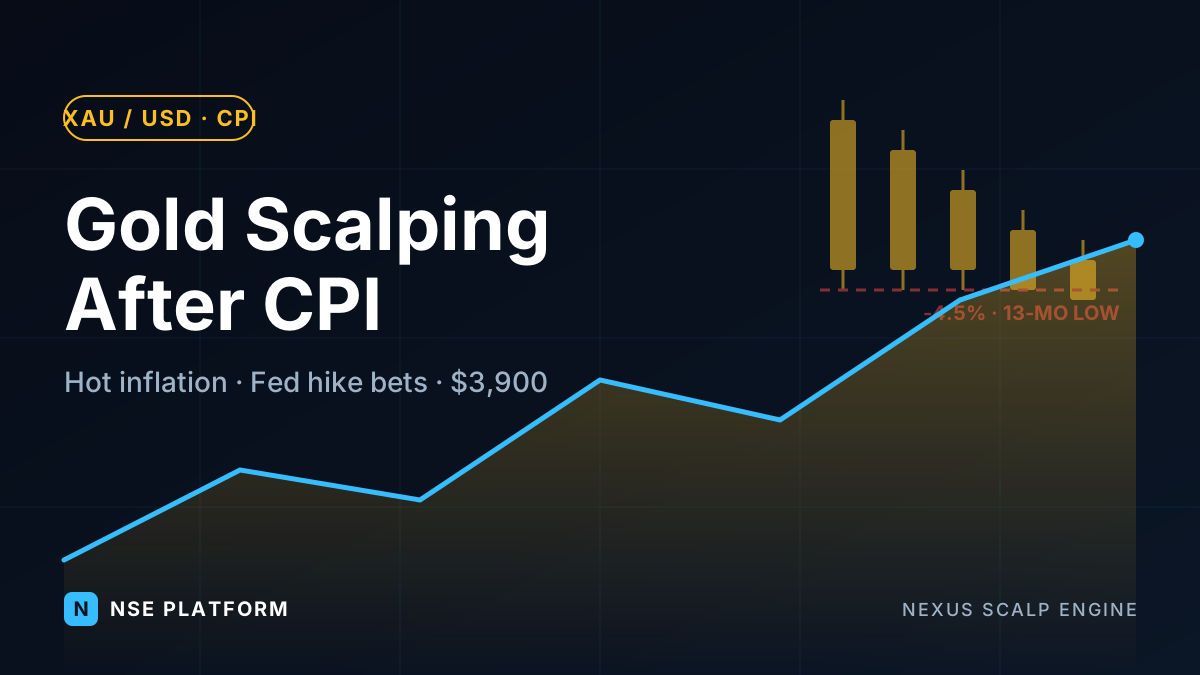
Gold lost 4.5% last week and slid to its lowest level in more than a year. The cause was not a gold story — it was an inflation story: hotter-than-expected US consumer and producer prices put a December Federal Reserve rate hike back on the table, the dollar firmed, and gold paid for it. For scalpers, the question is not whether gold will recover. It is how to trade a market that now moves on Fed repricing, with spreads that widen violently around every release.
This guide answers that question with the facts first and a plan second. It covers what actually happened last week, why hot inflation pushes gold down, what the move means for your costs and your sessions, and the concrete post-CPI rules: when to stand aside, when to re-enter, and which levels invalidate the plan.
Gold scalping after CPI means trading the aftermath, not the print: gold fell 4.5% last week to a 1-year low near $3,830 after US CPI came in at 0.4% against a 0.3% forecast, lifting December Fed hike odds to about 94%. Stay flat through the release, re-enter only when the spread is back under $0.35, and trade the post-release structure.
Key takeaways
- Gold fell 4.5% last week to a 13-month low after hot US CPI (0.4% vs 0.3% forecast) and PPI (+0.3% in October, biggest annual gain in four years).
- CME FedWatch pricing put a 25bp December hike at about 94%; the Fed held rates at 3.75%–4.00% on 28 October.
- Do not scalp through the release: be flat 15 minutes before, and wait until the spread is back under $0.35.
- Resistance is $3,900, then $3,960, then $4,000. Support is the $3,868 cycle low, then $3,800 — a sustained break of $3,800 changes the picture.
- Next catalysts: Fed Chair Warsh speaks on Monday, US retail sales on Tuesday, UK CPI and FOMC minutes on Wednesday.
What happened: the numbers as reported
Friday 13 November — US PPI. The US Bureau of Labor Statistics reported that the Producer Price Index for final demand rose 0.3% in October, a sharp deceleration from September's upwardly revised 1.4% reading — but the annual gain was the biggest in four years. Reuters reported the figures on Monday morning, and FXStreet's gold coverage cited the same release as part of the pressure on bullion.
The CPI print behind it. October US CPI came in at 0.4% against a 0.3% forecast, with core also firm. The two prints together told one story: inflation is not falling fast enough for the Fed to look through it.
Gold's reaction. Bullion dropped 4.5% last week, its worst week in the current cycle, and touched its lowest level in more than a year. Spot gold traded at $3,868.88 an ounce at 01:38 GMT on Monday 16 November, and at $3,877.66 by 02:48 GMT, according to Reuters — just above the cycle low near $3,868.92 cited by FXStreet. US gold futures for December delivery traded near $3,880. The metal spent Monday's Asian session pinned below the $3,900 mark, with repeated attempts to reclaim it attracting sellers.
Rate expectations. Markets now assign about a 94% chance to a 25-basis-point Fed hike in December, with a 6% chance of a larger 50-point move, according to CME's FedWatch tool as cited by Reuters. A week ago that hike was a debate; after the inflation prints it is the base case. The Federal Reserve held its target range at 3.75%–4.00% at its 27–28 October meeting, and its next decision is on 9 December.
What is still to come this week. Fed Chair Kevin Warsh speaks later on Monday, and the minutes of the October FOMC meeting are due on Wednesday 18 November at 19:00 UTC. Both will be read for any softening — or hardening — of the hike path.
Why hot inflation pushes gold down
The mechanism is short and worth understanding, because it tells you which releases matter and which do not.
Hot CPI and PPI raise the odds that the Fed keeps rates higher for longer, or hikes again. Higher US rates lift Treasury yields and the dollar, and gold — which pays no yield and is priced in dollars — becomes more expensive to hold and less attractive against yield-bearing assets. That is the whole chain: inflation print, rate repricing, dollar up, gold down.
Two details matter for scalpers. First, it is the repricing that moves gold, not the print itself: the biggest moves happen in the minutes after the release, when the market re-rates the December hike odds. Second, gold's reaction is asymmetric around round numbers. The break below $4,000 — a psychological level gold had defended for weeks — turned a data reaction into a technical breakdown, with stops below the level accelerating the fall toward $3,868. That is why the levels below matter more than any single forecast.
What it means for scalpers
Spreads. This is the first and largest effect. Gold spreads widen sharply around US releases, and a scalp entered at a $1.00 spread with a $6 target gives away about 17% of the target before slippage. Normal gold spreads for scalping are $0.20–$0.35. If your platform shows wider than $0.35, do not scalp gold — wait. The spread is the market telling you the edge is gone.
Sessions. The London–New York overlap (12:00–16:00 UTC) is now the only window with both liquidity and direction: London morning sets the tone after the Asian range, and New York brings the US data and the Fed speakers. The Asian session is thinner than usual while the market waits on Warsh and the FOMC minutes — expect choppy, low-conviction movement and wider spreads overnight.
Volatility. A 4.5% weekly fall means daily ranges have expanded. Stops sized for last month's gold will be hit by this month's noise. Re-measure the M5 ATR before every session and re-size from it — a stop that was $4 two weeks ago may need to be $6 now, with the lot cut accordingly. If the ATR stop is more than twice your usual stop, the session has changed character: reduce size, widen targets, or stand down.
Direction. Gold is below all of its major moving averages — the 21, 50, 100 and 200-day — and below $4,000. That is a bearish structure, not a prediction: it means pullback shorts have the trend behind them and longs are counter-trend until $4,000 is reclaimed. Counter-trend scalps are not forbidden, but they need a tighter stop and a smaller size, because the market is leaning the other way.
The setup it creates: post-CPI rules
No one should scalp through a CPI release. The setup is for the aftermath, and it has four rules.
Rule 1 — the blackout. Be flat 15 minutes before any red-folder US release, and stay out for 15 minutes after. The first minutes after a print are whipsaw: the market reprices, stops hunt, and spreads are at their worst. The move you miss in those 15 minutes is not your edge; the move you catch after the spread normalises might be.
Rule 2 — the spread check. Re-enter only when the gold spread is back under $0.35 and has stayed there for at least two minutes. If it is still wide after 15 minutes, the market is still repricing: wait.
Rule 3 — trade the structure, not the news. After the release, use the existing XAUUSD rules: 15-minute EMA 50 for direction, 5-minute pullbacks to the EMA 21, 1-minute trigger. The news changes the volatility and the levels; it does not change the setup. If no pullback forms, there is no trade — the release is not a reason to chase.
Rule 4 — the levels are the invalidation. Resistance: $3,900 first, then $3,960, then $4,000. Support: the $3,868 cycle low, then $3,800. The plan changes only if a level breaks and holds:
| Scenario | Condition | What changes |
|---|---|---|
| Bearish continuation | Gold stays below $3,900 and breaks $3,868 | Pullback shorts stay favoured; longs need a reclaim of $3,900 first |
| Stabilisation | Gold reclaims and holds $3,900 | Range scalping between $3,900 and $3,960; no trend trades yet |
| Bullish repair | Gold reclaims $4,000 | The breakdown is repaired; the bearish bias is off until proven otherwise |
| Deeper breakdown | Sustained break below $3,800 | The correction extends; stand aside or reduce size — do not catch the knife |
These are scenarios with invalidation conditions, not predictions. If the level breaks, the plan changes; if it holds, the plan holds.
Worked example: the post-release scalp, labelled as example
Example — not live prices. The numbers below use stated assumptions so the arithmetic can be checked.
Monday, after the Asian session: gold is trading near $3,890 (example price), below $3,900 resistance and above the $3,868 low. The 15-minute EMA 50 is above price — bearish bias. A 5-minute pullback rises toward the EMA 21 and rejects; a bearish candle closes below the EMA 9. Entry short at $3,888 (example). Stop above the pullback high at $3,894 — a $6 stop. Target 1.5R: $3,879, a $9 target.
Account $5,000, risk 0.5% = $25. One 0.01 lot of gold is 1 ounce, worth $1 per $1 move, so size = $25 ÷ $6.00 = 4.16 ounces = 0.04 lots, rounded down. At a $0.30 spread, the cost is 5% of the stop and 3.3% of the target — acceptable. The trade is invalidated if price closes back above $3,900: the short thesis is wrong, and the loss is capped at $25.
If, instead, the spread at entry is $0.90, the cost is 15% of the stop. The trade is skipped — not resized, not chased. The setup will come again; the account only needs to survive until it does.
What to watch next
- Monday 16 November: Fed Chair Kevin Warsh speaks later in the day. Any comment on the December meeting moves hike odds and gold within minutes. Treat the speech like a data release: flat beforehand, spread check after.
- Tuesday 17 November: US retail sales for October, 13:30 UTC. A strong print reinforces the hawkish case; a soft print is the first thing that could soften it.
- Wednesday 18 November: UK CPI at 07:00 UTC, then the FOMC minutes at 19:00 UTC. The minutes are the week's main event for gold — they show how close the October decision was and how the committee is thinking about December.
- Levels: $3,900 and $4,000 above, $3,868 and $3,800 below. Watch the closes, not the wicks: a level is broken when price closes beyond it and stays there, not when a spike touches it.
Frequently asked questions
Should I scalp gold during the CPI release itself?
No. Spreads widen, slippage jumps, and the first move is often a fake-out. Be flat 15 minutes before and after, then trade the structure that forms once the spread normalises.
Why did gold fall when inflation was hot?
Because hot inflation raises the odds of higher US rates, which lifts the dollar and Treasury yields. Gold pays no yield, so higher rates make it less attractive to hold. It is the rate repricing, not the inflation number alone, that moves gold.
Is $3,800 the level that matters most?
It is the nearest level whose break would change the picture: FXStreet and FX Leaders both flag the $3,800 area as the line below which the correction deepens. Until it breaks, the move is a sharp pullback inside a larger structure; if it breaks and holds, reassess rather than buying the dip.
Can I still scalp gold long in this market?
Yes, but as a counter-trend trade: smaller size, tighter stop, and only at a clear level with confirmation. Longs become the with-trend trade only if gold reclaims and holds $4,000.
Related reading
- XAUUSD Scalping Strategy — the full gold setup: H1 bias, 5-minute VWAP filter, 1-minute trigger, London sweep.
- Forex Week Ahead: 16–20 November — the full calendar for this week: retail sales, UK CPI, and the FOMC minutes.
- Best Indicators for Scalping — the EMA, RSI, and VWAP settings used in the post-release rules.
Sources consulted
- Gold holds below $3,900, near YTD low as Fed bets lift USD — FXStreet
- Gold edges higher as investors await Warsh remarks for rate signals — Reuters
- Gold scalping strategy: XAU/USD guide 2026 — ForexTradeLab
- Gold price forecast: XAU/USD needs to recover $4,000 quickly — FX Leaders
Educational material only — not financial advice. Forex and gold trading with leverage can produce substantial losses. Backtest and demo-trade any setup before risking real capital.