
Gold broke below $3,800 in Asian trade on Wednesday 18 November 2026, falling about 1.4% to near $3,795 with an intraday low of $3,792.12 — the first break below $3,800 since 30 September 2025 (BigGo Finance, 03:25 UTC). The driver is not a headline from the Middle East. It is the 10-year Treasury yield near 5.1% and a December rate hike priced at about 96% (CME FedWatch, via InvestingLive, 03:23 UTC).
Yesterday's piece on this blog covered the valuation angle — a one-year low near $3,830 against Morgan Stanley's $5,250 long-term call. This one is the event itself, the mechanism behind it, and the execution rules for scalping gold while it trades as a rates instrument. The winning edge in one sentence: every ranking page tells investors why gold broke $3,800 — this is the only one that tells scalpers how to trade it, with retest rules, spread and session filters, and the exact levels that invalidate each side.
Gold broke below $3,800 on 18 November 2026 because the 10-year Treasury yield near 5.1% and a December Fed hike priced at about 96% raised the cost of holding non-yielding gold, while the dollar sat near a 19-month high. For scalpers, the trade is the $3,800 retest and the $3,750 support below it — not the headline.
Key takeaways
- The break happened in thin Asian trade. A level broken in Asia is a candidate, not a confirmation — the breakdown needs London and New York to hold below $3,800 before it counts.
- Gold is trading as a rates instrument now: yields and Fed pricing lead, geopolitics lags. An oil spike from the Iran war works against gold, because higher oil feeds inflation, which feeds hike bets.
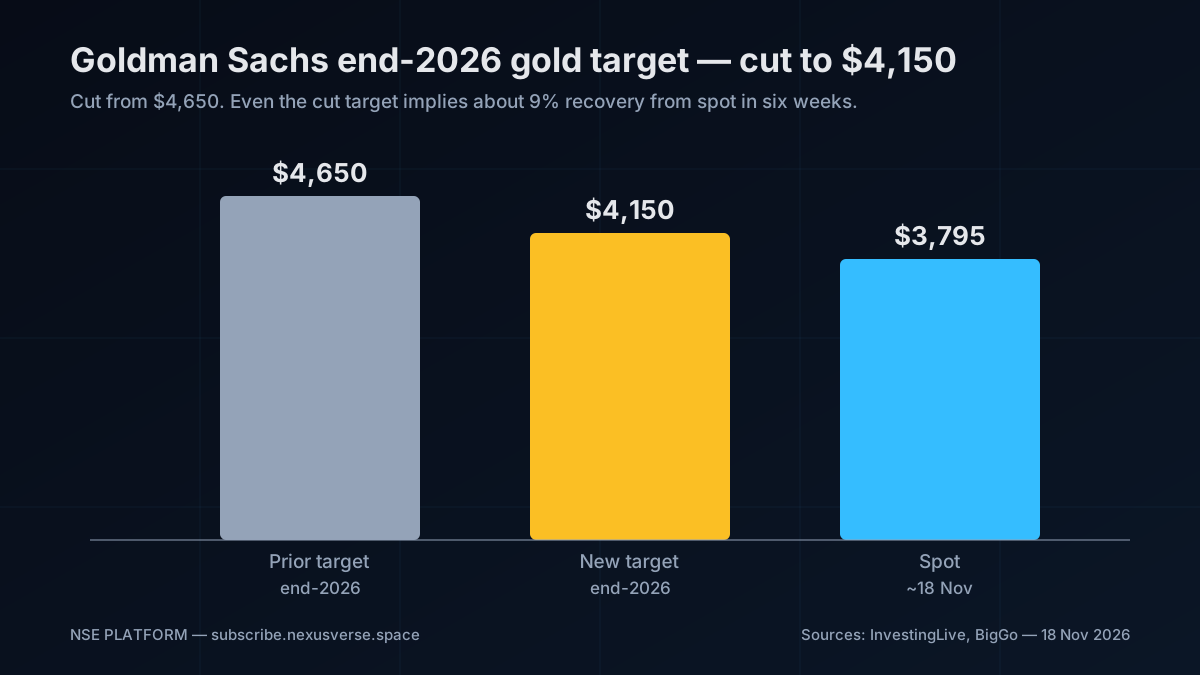
- Goldman Sachs cut its end-2026 gold target to $4,150 from $4,650 — still about 9% above spot. The cut itself is the story: the bank sees no quick recovery.
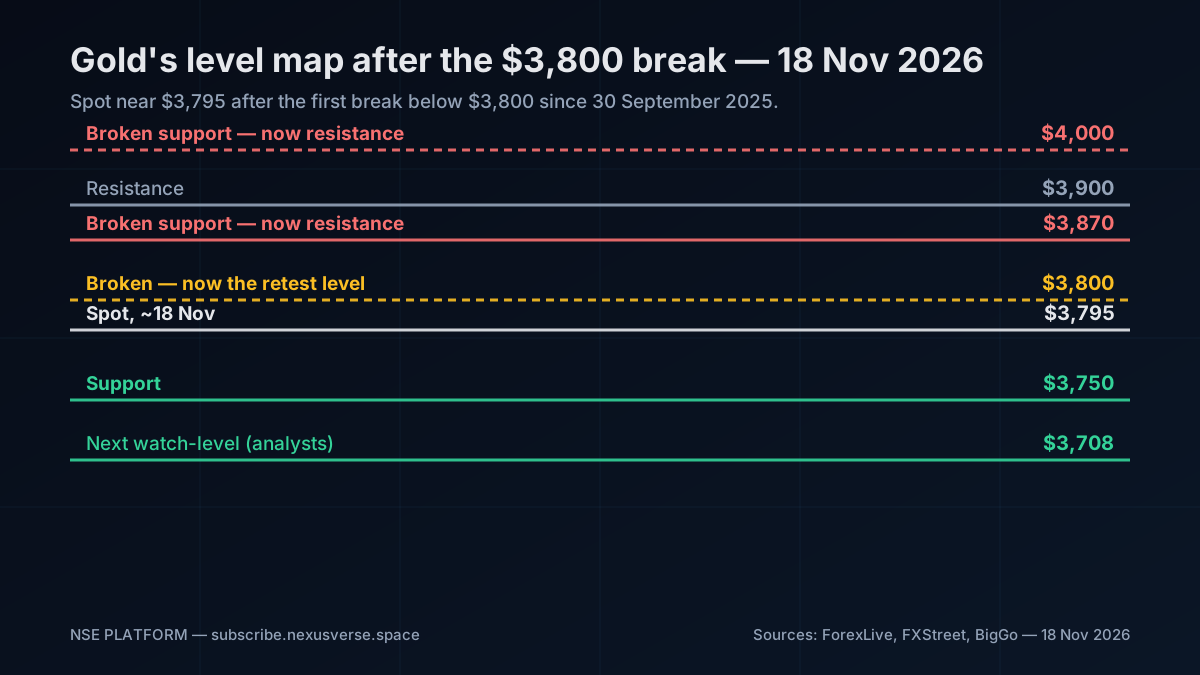
- The scalper's levels: resistance $3,870 (broken support), then $3,900 and $4,000; support $3,750, then $3,708. The trade is the $3,800 retest, not the chase.
- The FOMC October minutes land later today. No new positions around the release — the minutes are the one event that can reverse this move in minutes.
What happened: the break, the numbers, the sources
The sequence, all from this morning's reporting:
- Spot gold fell about 1.4% to near $3,795, intraday low $3,792.12 — the first trade below $3,800 since 30 September 2025 (BigGo Finance, 03:25 UTC). COMEX December gold had closed Monday down $33.30 (−0.9%) at $3,853.
- The 10-year Treasury yield sits near 5.1%, after closing at 5.15% on 13 November (Mitrade/BeInCrypto, 17 November). The 2-year yield is near 4.86% and the dollar is at a 19-month high (InvestingLive).
- A December hike is about 96% priced (CME FedWatch), with a small chance of a 50-basis-point move. Fed Governor Waller has floated a half-point hike if core inflation runs hot; St. Louis Fed President Musalem said "several" hikes are coming before spring; New York Fed President Williams said there is "still work to do" on the 2% target (TradingView/Moneycontrol, 02:36 UTC).
- US retail sales rose 0.2% in October, against 0.8% prior — in line with expectations, and no relief for gold (FXStreet, 02:12 UTC, citing the US Census Bureau).
- Goldman Sachs cut its end-2026 target to $4,150 from $4,650 (InvestingLive, BigGo). Even the cut target implies roughly 9% recovery in six weeks. The bank's end-2027 figure is reported differently by different sources, so it is not used here.
- Silver fell with gold, down about 2.6% to $46.18 (TradingView/Moneycontrol). Gold is 31.5% below its January record and heading for its worst year since 2015 (Mitrade/BeInCrypto).
Why it moved: gold is a rates instrument this week
The mechanism is straightforward and every source agrees on it. Gold pays no yield. When the 10-year Treasury pays 5.1%, holding gold costs the holder that 5.1% in forgone income — and a December hike priced at 96% means the cost of holding is still rising. Add a dollar near a 19-month high, which makes gold more expensive for buyers in other currencies, and the metal has two headwinds and no tailwind.
The counterintuitive part is the one traders get wrong: escalation in the Middle East is a headwind for gold right now, not support. Higher oil lifts inflation expectations, higher inflation expectations lift Fed hike bets, and hike bets lift yields — which is exactly what is pressing gold down. InvestingLive's framing is the sharpest on the SERP: gold's worst enemy right now is a 5% Treasury yield, not the headlines from the Middle East.
Underneath, the flow picture is mixed: third-quarter ETF inflows were 211 tonnes with holdings at a record 4,256 tonnes, and central banks bought an estimated 60 tonnes a month in 2026–27 against a pre-2022 average of 17 (BigGo). That is long-term support, not a reason to buy the break — ETF holders selling into a falling market are the self-reinforcing slide Goldman warned about yesterday.
What this means for scalpers
Three implications follow directly from the news, and none of them is "buy because it is cheap now":
- Trade the retest, not the breakdown. The break printed in Asia, the thinnest session. A level broken in Asia and reclaimed in London is a trap, not a trend. Wait for the retest of $3,800 from below and trade the rejection — or wait for London to hold below $3,795 before trading continuation.
- Yields lead gold. While the 10-year yield pushes higher, a gold long trades against the driver. Size it smaller or skip it, and watch the yield — not the gold chart — for the turn.
- The minutes are the event. The FOMC October minutes land later today. A dovish surprise is the main short-covering trigger named across the sources — and the reason no position should be open into the release.
The setup: retest short and breakdown continuation
Use the backbone from our XAUUSD scalping strategy — 5-minute bias, 1-minute trigger — with these rules for this week:
- Bias: short only below $3,800 and the 5-minute 20 EMA; long only above $3,870 and the 5-minute 20 EMA; flat between $3,800 and $3,870. No bias, no trade.
- Retest short (the main trade): price returns to $3,800 from below and prints a 1-minute rejection — a wick above $3,800 with a close back below. Enter on the open of the next 1-minute candle. Stop $2.50 above the rejection high. Target $3,792, then $3,750.
- Breakdown continuation: if London holds below $3,795 into the overlap, short pullbacks to the 5-minute 20 EMA with the same $2.50 stop. Target $3,750, then $3,708 (the level "some analysts" are watching, per InvestingLive — attributed, not confirmed).
- Reclaim rule: a 5-minute close back above $3,805 invalidates the short bias. Do not flip long on the reclaim — the reclaim only cancels the short. Longs need $3,870 reclaimed with a 5-minute close above it.
- Spread filter: do not scalp gold if your spread is above $0.35. Around the FOMC minutes it will widen past $0.50 — stand down, as our gold scalping strategy cost math shows.
- Size: risk 0.25%–0.50% per trade, 2% daily loss limit, pause after 3 consecutive losses. See ATR position sizing for scalping for the division.
- Event gate: no new positions from 30 minutes before the FOMC minutes release until 30 minutes after. No exceptions — the minutes are the named catalyst for a short-covering spike.
The cost math: what a gold scalp needs to break even
Round-trip cost is spread plus commission: $0.30 spread + $0.35 commission per 0.1 lot, about $0.34 per ounce. Break-even win rate is net loss divided by net win plus net loss, after costs.
| Setup | Stop | Target | Round-trip cost | Cost as % of target | Break-even win rate |
|---|---|---|---|---|---|
| $3 stop, 1R target | $3.00 | $3.00 | $0.34 | 11.3% | 55.7% |
| $3 stop, 1.5R target | $3.00 | $4.50 | $0.34 | 7.6% | 44.5% |
| $2.50 stop, 1.5R target | $2.50 | $3.75 | $0.34 | 9.1% | 45.4% |
The 1R trade needs 55.7% to break even — that is the tax on impatience. The 1.5R trade needs 44.5%. In a rates-driven market where the spread widens around every Fed headline, the wider target is not a preference, it is the trade.
Scenarios: what breaks the view
| Scenario | Trigger | Action | Invalidation |
|---|---|---|---|
| Retest fails | $3,800 rejects on M1, close back below | Short the rejection, target $3,792 then $3,750 | M5 close above $3,805 |
| Breakdown holds | London holds below $3,795 into the overlap | Short pullbacks to M5 20 EMA, target $3,750 | M5 close above $3,800 |
| Minutes surprise dovish | FOMC minutes soften the hike path | Stand aside; do not chase the spike either way | N/A — wait 30 minutes, re-read the levels |
| Reclaim | M5 close above $3,870 | Short bias cancelled; longs need confirmation above $3,870 | M5 close below $3,860 |
Worked example — the retest short
Example — not live prices. The $3,800 level and spot near $3,795 are from this morning's reporting; the entry, stop and target are illustrative.
Account: $10,000. Risk 0.5% = $50. London session, gold retests $3,800 from below and prints a 1-minute rejection with a high of $3,801 and a close back below $3,798.
Entry $3,798 on the open of the next 1-minute candle. The rejection high is $3,801, so the stop is $2.50 above it at $3,803.50 — a stop distance of $5.50. Target 1.5 × $5.50 = $8.25 → $3,789.75, just below the $3,792 intraday low and on the way to $3,750.
Position size: one lot of XAUUSD is 100 ounces, so $1 of gold movement is $100 per lot. Lot size = $50 ÷ ($5.50 × $100) = $50 ÷ $550 = 0.09 lots. Round down to 0.09.
Cost check: net win = $8.25 − $0.34 = $7.91; net loss = $5.50 + $0.34 = $5.84. Break-even = $5.84 ÷ $13.75 = 42.5%. The trade is worth taking above 42.5% — and only if the spread at entry is under the $0.35 cap and the minutes are not due within 30 minutes.
When NOT to trade gold today
- The Asian break itself. Never chase a level broken in thin Asian trade. The break is the alert; the London retest is the trade.
- Into the FOMC minutes. No new positions from 30 minutes before the release until 30 minutes after. A dovish surprise squeezes shorts in minutes.
- Spread above $0.35. Gold spreads widen around Fed headlines. Above the cap, the cost math fails and the trade is off.
- Long into a rising yield. While the 10-year yield pushes above 5.1%, a gold long fights the driver. Wait for the yield to turn, not for gold to look cheap.
- Below $3,750 without a plan. If $3,750 breaks, the next level is $3,708 — an analyst watch-level, not a tested floor. Do not add to shorts into untested air.
Frequently asked questions
Why is gold falling below $3,800?
Gold is falling below $3,800 because the 10-year Treasury yield near 5.1% raises the cost of holding non-yielding gold, while a December Fed hike is about 96% priced and the dollar sits near a 19-month high. Middle East headlines are not supporting gold — higher oil feeds inflation expectations, which feed hike bets, which lift yields further.
Is gold a good buy below $3,800?
Not on the break alone. The $3,800 level broke in thin Asian trade, Goldman Sachs cut its end-2026 target to $4,150 from $4,650, and the FOMC minutes later today could move the market either way. A buy needs a reclaim of $3,870 with a 5-minute close above it, or a confirmed hold of $3,750 — not a price that merely looks low.
How do you scalp gold when yields are rising?
Trade the retest of broken levels, not the breakdown: short the $3,800 retest with a $2.50 stop above the rejection high, keep targets at 1.5R so the $0.34 round-trip cost stays under 10% of the target, cap the spread at $0.35, and stay flat around the FOMC minutes.
What happens if gold breaks $3,750?
If $3,750 breaks, the next watched level is $3,708, named by analysts cited in this morning's reporting — but it is a watch-level, not a tested floor. Below $3,750, shorts should not add size into untested air, and the short bias stays invalidated only by a 5-minute close back above $3,800.
Related reading
- Gold at a One-Year Low vs Morgan Stanley's $5,250 Call — yesterday's valuation angle: the one-year low near $3,830 against the long-term bank targets. Today's piece is the event and the execution rules.
- XAUUSD Scalping Strategy: The M1 Execution Playbook — the 5-minute bias, 1-minute trigger backbone this week's rules run on.
- Gold Scalping Strategy: XAUUSD vs Gold CFDs, Costs & Sessions — the full gold cost math and the $0.35 spread cap.
- ATR Position Sizing for Scalping — the sizing division used in the worked example.
Sources consulted
- Gold's worst enemy right now is a 5% Treasury yield — InvestingLive
- Gold retains bearish tone below $3,800 as hawkish Fed bets support USD — FXStreet
- Rate-Hike Bets Bite as Spot Gold Breaks Below $3,800 — BigGo Finance
Educational material only — not financial advice. Forex and gold trading with leverage can produce substantial losses. Backtest and demo-trade any setup before risking real capital.