
This is a confirmation week, not a prediction week. The market spent last week repricing the Federal Reserve after hot US inflation — gold fell 4.5% to a 13-month low, and a December hike went from a debate to a roughly 94% probability. This week tests whether that repricing holds: US retail sales and the FOMC minutes will either confirm the hawkish turn or soften it, and UK CPI decides whether sterling joins the story.
For scalpers, the week is a calendar to trade around, not a forecast to bet on. Below is the calendar that matters, the pairs in focus, the scenarios with the levels that would invalidate them, and the session-by-session plan.
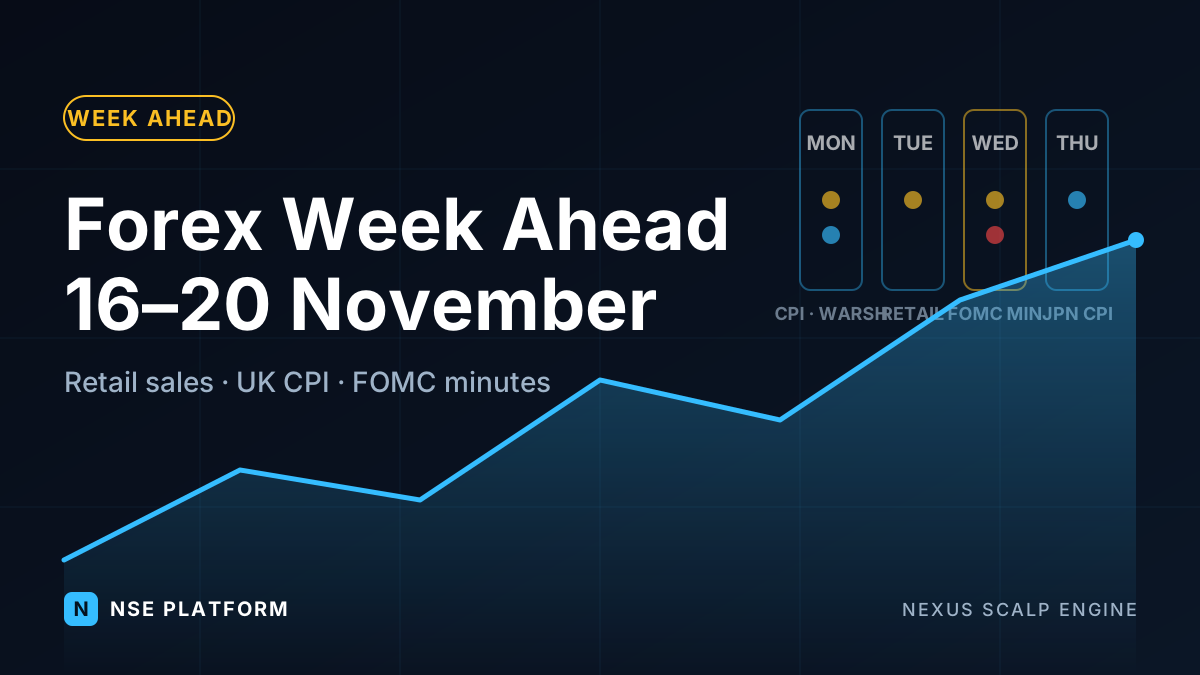
The forex week ahead for 16–20 November turns on whether US data and Fed communication confirm December hike pricing: Canada CPI and Warsh speak Monday, US retail sales land Tuesday, UK CPI and FOMC minutes arrive Wednesday. For scalpers: no trades 15 minutes either side of red-folder releases, and every scenario judged by its invalidation level.
Key takeaways
- Monday: Canada CPI 13:30 UTC and Fed Chair Warsh speaks — the first test of the hawkish repricing.
- Tuesday: US retail sales 13:30 UTC — a strong print confirms the hike case; a soft print softens it.
- Wednesday: UK CPI 07:00 UTC, then the FOMC minutes 19:00 UTC — the week's main event for the dollar and gold.
- Thursday: Australia jobs, Philly Fed, Japan CPI. Friday: UK retail sales and final US consumer sentiment.
- Pairs in focus: EUR/USD, GBP/USD, USD/CAD, XAU/USD, AUD/USD.
The calendar: what matters and when
All times UTC; forecasts are consensus figures from the sources below.
| Day | Time (UTC) | Event | Forecast | Previous |
|---|---|---|---|---|
| Mon 16 Nov | 02:00 | China industrial production, retail sales | — | — |
| Mon 16 Nov | 13:30 | Canada CPI m/m (Oct) | 0.3% | 0.1% |
| Mon 16 Nov | 13:30 | Canada CPI y/y (Oct) | 3.2% | 3.1% |
| Mon 16 Nov | 17:00 | Fed Chair Warsh speaks | — | — |
| Tue 17 Nov | 07:00 | UK labour market, avg earnings 3m/y | 3.5% | 3.7% |
| Tue 17 Nov | 13:30 | US retail sales m/m (Oct) | — | — |
| Tue 17 Nov | — | RBA meeting minutes; Nvidia earnings | — | — |
| Wed 18 Nov | 07:00 | UK CPI y/y (Oct) | 3.6% | 3.5% |
| Wed 18 Nov | 10:00 | Euro area final CPI y/y (Oct) | 4.0% | 4.0% |
| Wed 18 Nov | 19:00 | FOMC meeting minutes (Oct meeting) | — | — |
| Thu 19 Nov | — | Australia employment; Philly Fed index | — | — |
| Thu 19 Nov | 23:30 | Japan national core CPI y/y | 2.3% | 2.1% |
| Fri 20 Nov | — | UK retail sales; US consumer sentiment (final) | — | — |
Three releases carry the week. The FOMC minutes on Wednesday are the most important: they show how the October decision was argued and how the committee is thinking about December. US retail sales on Tuesday is the first hard data point since the inflation prints.
Pairs in focus
EUR/USD. Closed Friday at 1.1022. The pair's week is decided in New York, not Frankfurt: US retail sales and the FOMC minutes matter more than the euro area's final CPI print (4.0%, Wednesday). Watch the London open range each morning — in a repricing week, the Asian range is often swept at the open.
GBP/USD. Sterling has the busiest domestic calendar: labour market data Tuesday, CPI Wednesday, retail sales Friday. A hot UK CPI print would firm Bank of England expectations and support the pound; a soft print does the opposite.
USD/CAD. Canada CPI lands first, at 13:30 UTC on Monday, with the yearly rate forecast at 3.2% against 3.1% previously. A hotter print supports the Canadian dollar; a cooler one does the opposite. The pair also carries oil sensitivity — check the oil move before trading the CPI reaction, not after.
XAU/USD. Gold starts the week below $3,900, near its 13-month low around $3,868, after last week's 4.5% fall. The metal is the purest expression of the Fed repricing: every hawkish signal this week presses it, every dovish surprise lifts it. Resistance is $3,900, then $3,960, then $4,000; support is $3,868, then $3,800.
AUD/USD. The RBA minutes land Tuesday and Australian employment follows on Thursday. The Aussie moves on risk sentiment and on Monday's China data. If the week's data confirms the hawkish Fed path, risk sentiment softens and AUD/USD feels it.
Scenarios, each with its invalidation
No scenario below is a prediction. Each is a conditional: if this happens, then that follows; if the invalidation level breaks, the scenario is wrong and the plan changes.
Scenario A — the hawkish case holds. Retail sales firm, minutes hawkish, hike odds stay near 94% or rise. The dollar stays firm, EUR/USD stays heavy, gold stays below $3,900 with pressure toward $3,868. Invalidation: a soft retail print combined with dovish minutes language — if both happen, the repricing unwinds and this scenario is off.
Scenario B — the repricing softens. Retail sales disappoint, or the minutes show the committee more divided than the market assumes. Hike odds fall back, the dollar eases, EUR/USD recovers toward its recent range, and gold reclaims $3,900. Invalidation: a hot retail print or hawkish minutes — either one restores the hawkish case within the session.
Scenario C — sterling diverges. UK CPI comes in hot while US data is mixed. GBP/USD outperforms EUR/USD and the pound gets its own bid, while the dollar stays firm elsewhere. Invalidation: a soft UK CPI print — sterling then trades as a dollar story like everything else.
Scenario D — gold breaks $3,800. A hawkish surprise pushes gold through its $3,868 low and then through $3,800. The correction deepens. Invalidation: gold reclaims $3,900 and holds it. Do not buy the dip into a breakdown; wait for the level to be reclaimed.
Scenario E — nothing confirms, ranges hold. Data lands near forecast, minutes read balanced, the week trades sideways inside last week's ranges. Range edges, session opens, and mean reversion are the trades — no trend to chase. Invalidation: any single release that moves hike odds by more than a few points — then revert to scenarios A or B.
The scalping plan for the week
Sessions. Trade the London open (07:00–10:00 UTC) and the London–New York overlap (12:00–16:00 UTC). The Asian session is thin while the market waits on US data — use M5 there, or skip it. The 07:00 UTC UK releases fall at the London open: be flat before them, and let the first 15 minutes of the session settle before taking a position.
The news rule. No new trades 15 minutes either side of any red-folder release above. Resume only when the spread is back inside its normal range. Do not hold scalps into the 19:00 UTC minutes on Wednesday, and do not chase the first move after them.
The spread filter. EUR/USD: do not scalp above a 1-pip spread on M1 setups or 2 pips on M5 setups. Gold: do not scalp above $0.35. If the spread is wider than the filter, the setup is not available at any timeframe — wait for the next session.
Risk rules for the week. Risk 0.25%–0.50% per trade, with a hard 2% daily loss limit and a stop after three consecutive losses. In a repricing week the daily limit matters more than usual: one hawkish surprise can produce three fast losses before you reassess. Re-measure ATR before every session and re-size from it; ranges have expanded since last week.
Setups. The week's tradeable structures are the same as always: the London open range and its sweep, pullbacks to the EMA in the direction of the session bias, and the post-news structure once spreads normalise. What changes this week is the filter: more blackouts, tighter spread checks, and smaller size around the three big releases. A week with five red-folder events is a week to trade less, not more.
Risks and what would change the view
Two things would change this plan. First, a geopolitical shock — the Middle East tensions cited in Monday's gold coverage are already supporting the dollar; an escalation would move gold and oil together and override the data calendar. Second, a data surprise in either direction on retail sales or UK CPI — the scenarios above cover both, but the only correct response to a two-standard-deviation surprise is the blackout rule, not a fast entry.
The standing rule for the week: if the market does something the plan did not cover, the plan is wrong, not the market. Step aside, re-read the calendar, and trade the next session.
Frequently asked questions
What is the most important event this week?
The FOMC minutes on Wednesday at 19:00 UTC. They show how the October hold was argued and how close the committee is to a December hike — the question the whole week is priced around.
Should I hold trades through the FOMC minutes?
No. Close scalps before 19:00 UTC on Wednesday and do not chase the first move after. The minutes move the dollar and gold within minutes, and the first move is often reversed.
What if all the data comes in as forecast?
Then the week ranges, and range edges and session opens are the trades. A forecast outcome is still information: it confirms the repricing, which keeps the dollar firm and gold below $3,900.
Related reading
- Gold Scalping After CPI — the post-CPI gold plan: what happened, the levels, and the re-entry rules.
- EURUSD Scalping Strategy: The London Open — the session playbook for the week's London opens.
- XAUUSD Scalping Strategy — the full gold setup for the metal's volatile week.
Sources consulted
- Forex economic calendar this week — ForexTradeLab
- Economic calendar: CPI, FOMC and NFP dates — SwiftEdge
- Forex and crypto forecast November 16–20, 2026: Fed hike bets and Nvidia — NordFX
- Key economic events this week starting November 16, 2026 — AutoRebateForeX
Educational material only — not financial advice. Forex and gold trading with leverage can produce substantial losses. Backtest and demo-trade any setup before risking real capital.