
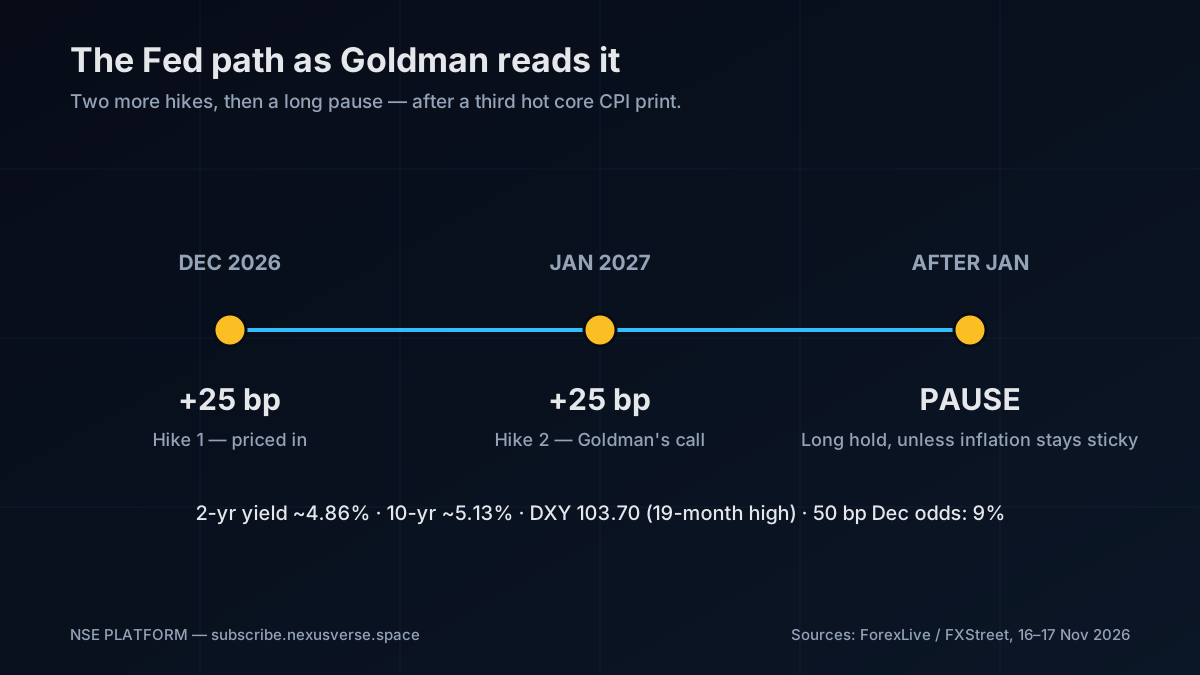
The Federal Reserve's path changed in one week, and the dollar noticed. Three consecutive strong core CPI readings convinced Goldman Sachs Asset Management that the summer slowdown was a blip: it now expects the Fed to hike in December and again in January, followed by a prolonged pause (ForexLive, 17 November 2026, 01:55 UTC). The two-year Treasury yield jumped to near 4.86%, the dollar index hit a 19-month high of 103.70, and the question for scalpers is no longer whether the Fed is hawkish — it is how to trade a dollar that is being repriced higher almost daily.
The winning edge in one sentence: this is the USD scalper's translation of the Fed reset — the exact prints, the exact yields, and the rules for trading with the dollar's momentum instead of fading it into every Fed headline.
The Fed is expected to hike in December and January, then pause, after US core CPI rose 0.3% in October for a third firm reading in a row. The two-year yield is near 4.86%, the 10-year near 5.13%, and the dollar index is at a 19-month high near 103.70. For scalpers, the rule is simple: buy dollar strength on pullbacks into the London–New York overlap, never short it into a Fed speaker, and stand down 15 minutes around every release.
What happened: three hot prints and one speech
The trigger was inflation. US core CPI rose 0.3% in October — an annualised pace of about 3.6% — beating expectations for a third firm reading in a row. Goldman says the run of three firm prints suggests the softer summer readings were temporary, not the start of a sustained slowdown. A January hike is a step beyond what the market has firmly priced, so Goldman's call leans against any rally at the front end.
The speech that lit the fuse came from Fed Governor Waller, who floated the idea of a larger 50 basis point hike at the December meeting if monthly core inflation came in around 0.3% or higher — which October's print did. Traders now see a 9% chance of a 50 basis point December hike, according to the CME FedWatch Tool, and MUFG notes the market is pricing three consecutive hikes in December, January and March, which would lift the effective Fed funds rate towards 4.6%.
The officials have been unanimous in tone since. Hammack said the economy can handle more restriction and that it is unclear how far the Fed has to go. Jefferson said inflation is the key signal for rates, with PCE still at 3.6%. Collins backed steady, gradual hikes and cooled talk of a bigger December move. Schmid said inflation is running too hot and the Fed has work to do — and would still be near 3% even without energy. The FXStreet Fed Sentiment Index sits firmly above 100, in hawkish territory.
The numbers that moved the market
| Actual | Expected / context | Source | |
|---|---|---|---|
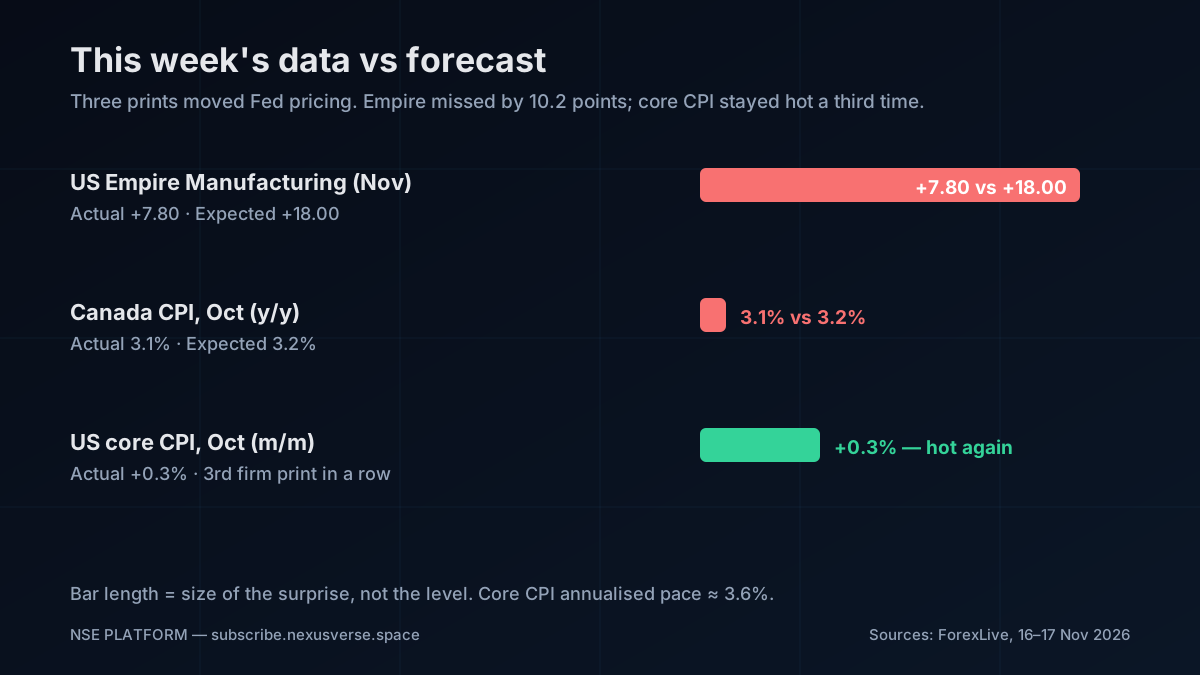
| US core CPI, Oct (m/m) | +0.3% | Third firm print in a row; ~3.6% annualised | ForexLive, 17 Nov 01:55 UTC |
| US Empire Manufacturing, Nov | +7.80 | +18.00 expected — a 10.2-point miss | ForexLive, 16 Nov 13:30 UTC |
| Canada CPI, Oct (y/y) | 3.1% | 3.2% expected | ForexLive, 16 Nov 13:30 UTC |
| 2-year Treasury yield | ~4.86% | Up from 4.19% since 18 August | ForexLive / FXStreet, 16–17 Nov |
| 10-year Treasury yield | ~5.13% | Above 5% for the first time in the cycle | FXStreet, 16 Nov |
| Dollar index (DXY) | 103.70 | 19-month high; ~103.50 after, highest since April 2025 | FXStreet, 16–17 Nov |
| 50 bp December hike odds | 9% | CME FedWatch Tool | FXStreet, 16 Nov |
Note the Empire miss: a soft activity print did not dent the dollar at all. That is the tell — in a hawkish repricing, inflation data outweighs growth data, and the dollar trades on the rate path, not the survey.
What this means for scalpers
- The dollar's bias is up until the data says otherwise. DXY at a 19-month high with yields above 5% is a trend, not a spike. Scalping EURUSD or GBPUSD long into this tape means fighting the driver — the better trade is shorting pullbacks in the dollar's favour, or staying flat and trading the crosses.
- Fed speakers are volatility, not entries. Every official this week has said the same thing in different words. The repricing happens in the first minutes after the headline, when spreads are widest. Trade the move after it settles, never the headline itself.
- The 50 basis point question is the week's binary. A 9% chance is small, but it is the number that would move everything at once. The FOMC minutes on Wednesday 18 November and the next CPI print are the tests — if officials start talking openly about January before December, the front end reprices again.
- Gold and the dollar are moving together against you if you are long either. Gold has repeatedly fallen as Fed hike expectations rise rather than acting as a haven. Do not hedge a dollar short with a gold long in this regime — they are the same trade.
The setup: trading with the dollar, not against it
Use the framework from our EURUSD London open playbook and best time to scalp forex, with these rules for this week:
- Bias: short EURUSD and GBPUSD on pullbacks while DXY holds above 103.00 and the 2-year yield is above 4.80%. Flip flat if DXY loses 103.00 on a daily close — that would be the first sign the repricing is pausing.
- Entry: on the 5-minute chart, wait for a pullback to the 20 EMA in the London–New York overlap (12:00–16:00 UTC), then a 1-minute rejection candle. Stop 8–10 pips above the pullback high. Target 15–20 pips, then trail.
- Size: risk 0.25%–0.50% per trade. The dollar is trending, so winners can run — but the same trend means a counter-trend entry bleeds fast. See ATR position sizing for scalping.
- Event gate: no new positions 15 minutes before and after Fed Chair Warsh's remarks, New York Fed President Williams speaking, the FOMC minutes on Wednesday 18 November, or US retail sales at 13:30 GMT today. The retail sales plan is in our US retail sales scalping article.
- Spread filter: EURUSD spread above 1.2 pips in the overlap means the market is still digesting a headline — wait for it to normalise.
- Daily stop: 2% daily loss limit, pause after 3 consecutive losses. A trending dollar punishes revenge trading harder than a ranging market does.
Worked example — not live prices
Example — not live prices. Account $10,000, risk 0.5% = $50 per trade. Short EURUSD at 1.0850 with a 10-pip stop: 1 pip on 0.10 lot of EURUSD is $1, so a 10-pip stop risks $10 per 0.10 lot. Position size = $50 ÷ $10 = 0.50 lot. Target 20 pips: 0.50 lot × 20 pips × $1 per pip per 0.10 lot = $100 before costs. Spread 0.8 pips on 0.50 lot costs $4. The example shows the asymmetry that makes this week tradable: the dollar's trend gives the 20-pip target a better chance than the 10-pip stop, but only if you enter on the pullback — chasing the move after it has run 30 pips turns the same math upside down.
When NOT to trade the dollar this week
- In the 15 minutes after any Fed speaker headline — the repricing is fastest and spreads are widest.
- Shorting the dollar because "it has gone up too much" — DXY at a 19-month high is a fact, not a reason to fade it. Fading needs a trigger: a soft CPI print, a dovish minute, a 2-year yield rolling over.
- During US retail sales at 13:30 GMT today — a soft print eases hike pressure and can reverse the dollar in minutes; a hot print extends it. Either way, the first move is not the trade.
- If the 2-year yield starts falling while DXY holds up — that divergence means the market is doubting the next hike, and the bias rules above stop applying.
What to watch next
- US retail sales, today 13:30 GMT — the first live test of the hawkish read. Soft eases pressure; hot extends it.
- FOMC minutes, Wednesday 18 November — does anyone talk openly about January? Is there pushback on a 50 basis point December move?
- Fed Chair Warsh and New York Fed President Williams speaking — tone over detail, as always.
- October PPI and the next CPI print — a fourth straight 0.3% core print puts the 50 basis point move firmly in play; a soft print unwinds the January hike.
FAQ
Is the Fed really going to hike in January? Goldman expects it, and the market has not firmly priced it — that is the point. A January hike is Goldman's call after three hot core CPI prints, not a done deal. The FOMC minutes and the next CPI print are the tests that decide it.
Why did the dollar ignore the weak Empire Manufacturing print? Because in a hawkish repricing, inflation data outweighs growth data. Empire missed by 10.2 points and the dollar barely moved — the market trades the rate path, and the rate path is set by CPI, not by a regional survey.
What would change the dollar's bias? A soft CPI print, a dovish surprise in the FOMC minutes, or the 2-year yield rolling over below 4.80% while DXY loses 103.00. Any one of those is a reason to flatten; all three together would flip the bias.
Can I scalp EURUSD long at all this week? Only as a counter-trend scalp with half size, a tight stop, and an exit at the first sign of rejection — and never into a Fed speaker. The trend is the dollar's; counter-trend trades pay less and fail more.
Sources consulted
- ForexLive / investingLive — "Two more Fed hikes, then a long pause: Goldman reads a third hot core CPI print", 17 Nov 2026, 01:55 UTC. https://investinglive.com/central-banks/two-more-fed-hikes-then-a-long-pause-goldman-reads-a-third-hot-core-cpi-print/
- FXStreet — "US Dollar Index extends gains as traders bet on a longer Fed hiking cycle", 16 Nov 2026. https://www.fxstreet.com/news/us-dollar-index-extends-gains-as-traders-bet-on-a-longer-fed-hiking-cycle-202611161214
- FXStreet — "United States Dollar Index retreats from 19-month high of 103.70, outlook remains bullish", 17 Nov 2026. https://www.fxstreet.com/news/united-states-dollar-index-retreats-from-19-month-high-of-10370-outlook-remains-bullish-202611170321
- ForexLive — "US November Empire Manufacturing index +7.80 vs +18.00 expected", 16 Nov 2026, 13:30 UTC; "Canada October CPI 3.1% vs +3.2% expected", 16 Nov 2026, 13:30 UTC. (Rows in the site's news database.)
Educational material only — not financial advice. Forex and gold trading with leverage can produce substantial losses. Backtest and demo-trade any setup before risking real capital.