
Ask five guides for the best forex pairs for scalping and you get the same list five times: EUR/USD, GBP/USD, USD/JPY, maybe AUD/USD. What none of them does is price the list. One page in the top five computes a monthly cost — for EUR/USD only, at one broker. The rest state that spreads matter and move on. Two of the five are broker pages steering you toward their own accounts, and one is an advertorial for a broker most readers have never heard of.
This comparison is broker-neutral and starts from the only question that decides the ranking: what does a 5-pip target cost on this pair? The winning edge in one sentence: every pair priced the same way — spread plus commission as a percentage of a 5-pip target, a break-even win rate per pair, a pair-by-session matrix, and an explicit spread cutoff for when not to trade.
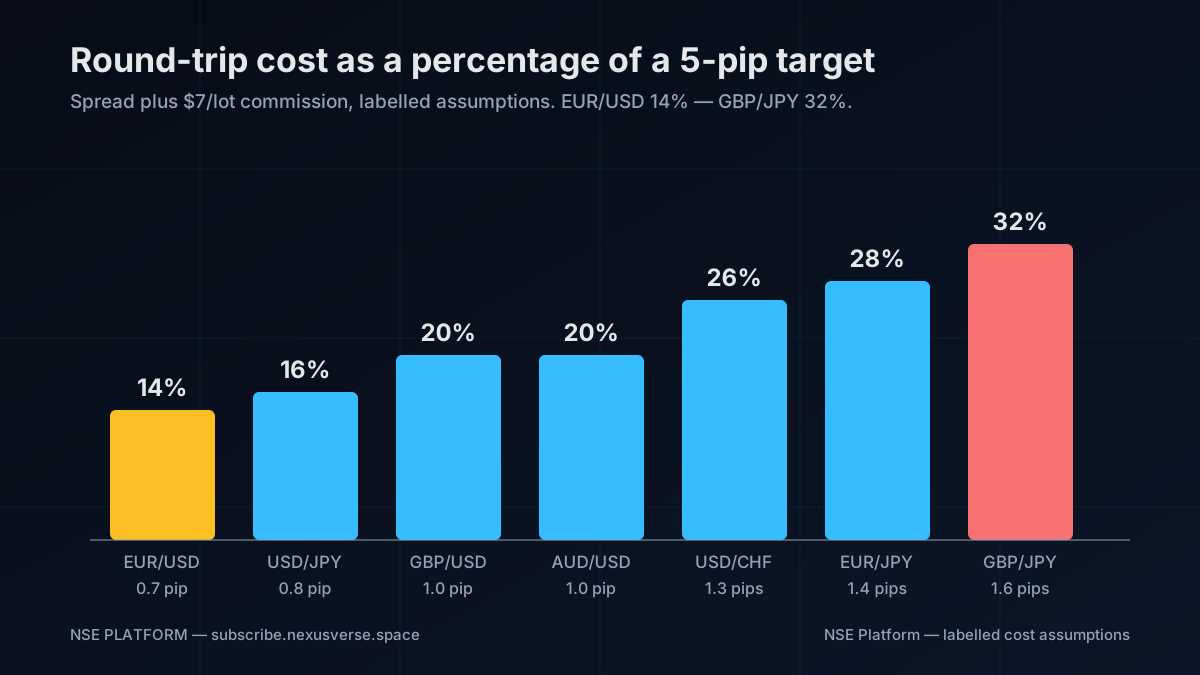
EUR/USD is the best forex pair for scalping for most traders: the tightest spread, the deepest liquidity in London and the overlap, and a 0.7-pip round-trip cost that takes only 14% of a 5-pip target. USD/JPY is the best second pair; GBP/USD pays only with wider targets.
Key takeaways
- The ranking is a cost ranking. A pair with a 1.6-pip round-trip cost needs a 66% win rate at 1:1; the same setup on EUR/USD needs 57%. That 9-point gap is the whole ranking.
- Spreads are labelled assumptions for a typical raw ECN account — mid-range values from the published ranges, not measured live spreads. Check your own account before trading any pair.
- Every pair has a session. EUR/USD in Asia is a different, worse trade than EUR/USD in London — the matrix below is the ranking, not the list.
- The spread cutoff is the rule that protects the ranking: do not scalp a pair when its spread is above the cutoff in the table. A cheap pair at a wide spread is an expensive pair.
- XAUUSD is not a forex pair, but it is the most-scalped instrument for much of the retail audience — and none of the five ranking pages lists it. The callout at the end prices it honestly.
The cost table: what a 5-pip target actually costs
Cost assumptions, labelled: typical raw ECN spread (mid-range of the published ranges) plus a $7 round-trip commission per lot, converted to pips at each pair's pip value. Slippage is excluded — add 0.1–0.3 pips around news. The break-even win rate is for a 1:1 trade (5-pip stop, 5-pip target): net loss divided by net win plus net loss, after costs.
| Pair | Typical raw spread | Round-trip cost | Cost as % of 5-pip target | Break-even win rate at 1:1 | Spread cutoff — do not scalp above |
|---|---|---|---|---|---|
| EUR/USD | 0.1 pip | 0.7 pip | 14% | 57.0% | 0.5 pips |
| USD/JPY | 0.2 pip | 0.8 pip | 16% | 58.0% | 0.6 pips |
| GBP/USD | 0.4 pip | 1.0 pip | 20% | 60.0% | 0.8 pips |
| AUD/USD | 0.4 pip | 1.0 pip | 20% | 60.0% | 0.8 pips |
| USD/CHF | 0.7 pip | 1.3 pips | 26% | 63.0% | 1.0 pips |
| EUR/JPY | 0.8 pip | 1.4 pips | 28% | 64.0% | 1.2 pips |
| GBP/JPY | 1.0 pip | 1.6 pips | 32% | 66.0% | 1.5 pips |
Read the table from right to left and it tells you the ranking. EUR/USD and USD/JPY are the only pairs where a 5-pip target keeps the cost under a fifth of the target. GBP/USD and AUD/USD are tradeable but need a 60% win rate at 1:1 — which means they need wider targets, not better entries. USD/CHF, EUR/JPY and GBP/JPY cross the line where the cost eats a quarter to a third of the target, and at that point the setup has to be genuinely good to survive.
The target size matters as much as the pair. The same table at a 10-pip target halves every cost percentage: EUR/USD drops to 7%, GBP/JPY to 16%. If you scalp 5-pip targets, trade the top two pairs. If you trade 10-pip targets, the middle of the table opens up. The pair ranking and the target size are one decision, not two.
The pair-by-session matrix
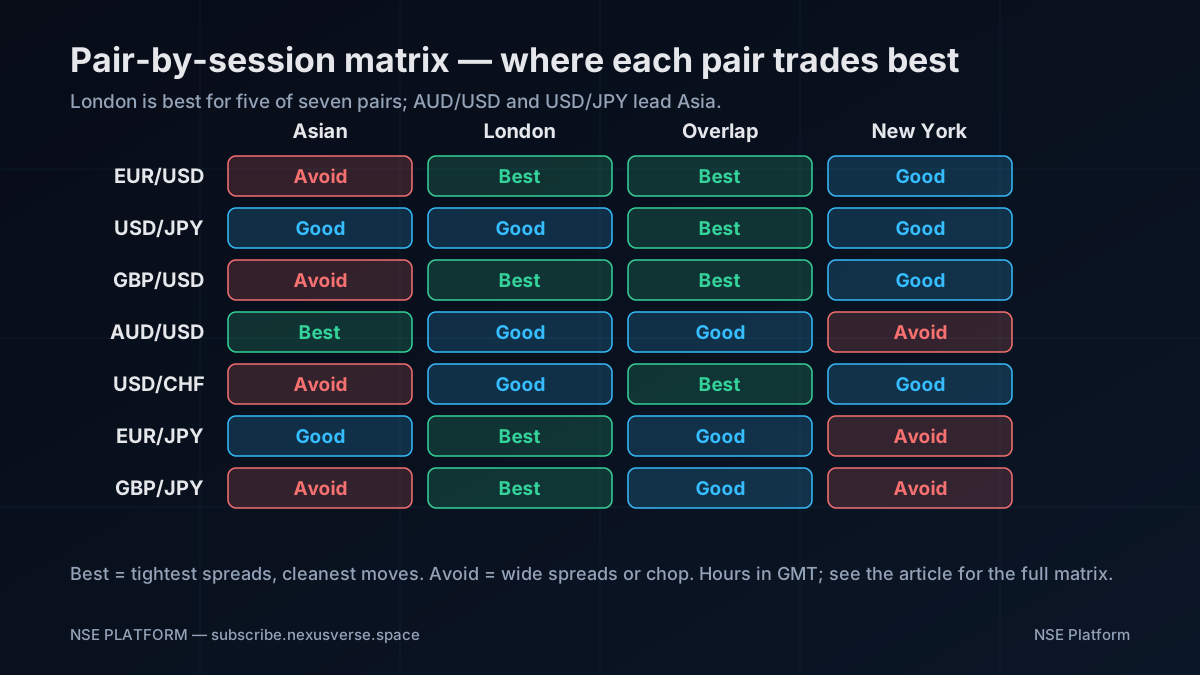
A pair is not one trade — it is four trades, one per session, and the spread moves between them. This matrix is the verdict per cell. "Best" means tightest spreads and cleanest moves; "Avoid" means the spread widens or the moves chop.
| Pair | Asian (00:00–06:00 GMT) | London (07:00–10:00 GMT) | London–NY overlap (13:00–17:00 GMT) | New York (17:00–21:00 GMT) |
|---|---|---|---|---|
| EUR/USD | Avoid | Best | Best | Good |
| USD/JPY | Good | Good | Best | Good |
| GBP/USD | Avoid | Best | Best | Good |
| AUD/USD | Best | Good | Good | Avoid |
| USD/CHF | Avoid | Good | Best | Good |
| EUR/JPY | Good | Best | Good | Avoid |
| GBP/JPY | Avoid | Best | Good | Avoid |
Three patterns to remember. First, London is the best session for five of the seven pairs — if you can only trade one window, trade London. Second, AUD/USD and USD/JPY are the Asian-session pairs: AUD/USD because Sydney and Tokyo are its home sessions, USD/JPY because Tokyo drives yen flows. Third, the New York afternoon is the worst window for the yen crosses and AUD/USD — liquidity thins, spreads widen, and the moves that remain are mostly position-squaring, not trends.
Spreads widen outside peak hours on every pair. The only page in the top five that says this with a number notes EUR/USD widening to 2–5 pips at rollover — above the 0.5-pip cutoff, which means the trade is off, not expensive. Check the spread on your own platform at the hour you trade, not the hour the guide was written.
The ranking, pair by pair
1. EUR/USD — the default. Tightest spread, deepest liquidity, most predictable session structure. The BIS Triennial Survey puts daily forex turnover at $9.6 trillion (April 2025), and EUR/USD is the largest slice of it. Best in London and the overlap; avoid in Asia. Difficulty: easy. First pair for every beginner, and the pair to return to whenever another pair stops paying.
2. USD/JPY — the best second pair. Nearly as cheap as EUR/USD, and the only major that trades well in Asia. The catch is the pip value: a 5-pip move on USD/JPY is a smaller dollar move per lot than on EUR/USD at the same account size, so size it from the ATR, not from habit. Best in the overlap and Tokyo; good everywhere else. Difficulty: easy.
3. GBP/USD — the volatile major. Wider spread, bigger moves, bigger stops. The 20% cost on a 5-pip target means GBP/USD needs a 10-pip target to price like EUR/USD at 5. Trade it in London, where the moves justify the cost; avoid it in Asia, where the cost stays and the moves go. Difficulty: medium.
4. AUD/USD — the session specialist. Same cost as GBP/USD, but its best session is the one most traders sleep through. If you trade Asia, AUD/USD is your EUR/USD. If you trade London, it is a second-tier pair with no advantage. Difficulty: easy in Asia, medium elsewhere.
5. USD/CHF — the quiet major. Cheap enough in London, but thin and slow — the moves are smaller, so the 26% cost bites harder in practice than on paper. A backup pair for London, not a primary. Difficulty: medium.
6. EUR/JPY — the cross for London only. Good moves in London, but the 28% cost on a 5-pip target means it needs 10-pip targets to work. Outside London the spread widens and the case disappears. Difficulty: medium-hard.
7. GBP/JPY — the expensive one. The widest spread, the wildest moves, the 66% break-even at 1:1. It pays only for traders who already profit on GBP/USD and want more volatility with wider stops and wider targets. Beginners who start here pay the most to learn the least. Difficulty: hard.
Verdict by trader type
- Beginner, first three months: EUR/USD only, London session, 10-pip targets. Learn one pair's behaviour before paying a second pair's spread.
- Asia-session trader: AUD/USD first, USD/JPY second. The London pairs are the wrong trade at 03:00 GMT, however cheap they look on paper.
- Experienced scalper, London session: EUR/USD and GBP/USD as the core, USD/JPY for the overlap. Add GBP/JPY only with 10-pip-plus targets and a proven win rate on GBP/USD first.
- Small account, under $1,000: EUR/USD only. The cost table is unforgiving at small size — a 32% cost on GBP/JPY is the difference between a learning curve and a blown account.
Gold is not a forex pair — but scalpers ask anyway
None of the five ranking pages lists XAUUSD, which is a gap: for much of the retail audience, gold is the most-scalped instrument. The honest pricing is that gold is expensive to scalp. A $0.34 round-trip cost on a $3 target is 11.3% of the target, and on a $1.50 target it is 22.7% — worse than GBP/USD at 5 pips. Gold needs M15 targets of $3 or more to price like EUR/USD, and it needs a spread cap of $0.35. Trade gold like a volatile cross, not like a major — and read our gold scalping strategy cost math before the first trade. See also gold vs EURUSD scalping for the full side-by-side.
When NOT to trade a pair
- Spread above the cutoff. The cutoff column is a rule, not a guideline. If EUR/USD shows 0.8 pips, the trade is off — wait for London, or trade nothing.
- Rollover, 21:00–22:00 GMT. Spreads widen to several pips on every pair. No pair is cheap at rollover.
- Thirty minutes either side of red-folder news. CPI, NFP, FOMC and retail sales widen every spread and invalidate every stop. Our US retail sales scalping plan covers the release playbook.
- A pair outside its session. EUR/USD in Asia and AUD/USD in late New York are the same mistake: the right pair at the wrong hour, paying the spread for chop.
- Exotics. None of the seven pairs above is exotic, and that is deliberate. Exotic spreads run 5–20 pips — a 5-pip target is smaller than the cost. Do not scalp them.
Frequently asked questions
What is the best forex pair to scalp?
EUR/USD is the best forex pair to scalp for most traders: the tightest spread, the deepest liquidity, and a 0.7-pip round-trip cost that takes only 14% of a 5-pip target. USD/JPY is the best second pair, especially for Asian-session traders. The ranking is a cost ranking — a pair with a 1.6-pip cost needs a 66% win rate at 1:1, against 57% for EUR/USD.
How many pips do scalpers target?
Most forex scalpers target 5–10 pips per trade, with stops of similar size. The target size decides which pairs are tradeable: at a 5-pip target only EUR/USD and USD/JPY keep the cost under a fifth of the target, while at a 10-pip target the cost halves and GBP/USD, AUD/USD and the yen crosses open up. Never set the target from habit — set it from the pair's cost table.
What is the best time to scalp forex?
The London session (07:00–10:00 GMT) and the London–New York overlap (13:00–17:00 GMT) are the best times to scalp forex for five of the seven major pairs. AUD/USD and USD/JPY are the exceptions — they trade best in the Asian session. The full pair-by-session matrix is in the table above, and our best time to scalp forex guide covers the session windows and daylight-saving shifts in detail.
What spread is too wide for scalping?
For EUR/USD, any spread above 0.5 pips is too wide for scalping — the trade is off, not expensive. The cutoff rises with the pair's normal spread: 0.6 for USD/JPY, 0.8 for GBP/USD and AUD/USD, 1.0 for USD/CHF, 1.2 for EUR/JPY, 1.5 for GBP/JPY. At rollover and around red-folder news, every spread exceeds its cutoff — stand down.
Can you scalp exotic pairs?
No — exotic pairs are not tradeable for scalping. Their spreads run 5–20 pips, which is larger than a typical 5-pip scalp target, so the cost exceeds the profit before the trade starts. Stick to the seven majors and crosses in the table, and check the spread against the cutoff before every session.
How do you size a position when switching pairs?
Size from the ATR and the dollar risk, never from habit. Lot size = dollar risk ÷ (stop distance × pip value), and the pip value differs per pair — a 5-pip stop on USD/JPY is not the same dollar risk as a 5-pip stop on EUR/USD. Our ATR position sizing guide shows the division for every pair type.
Related reading
- Forex Scalping for Beginners: One Simple M5 System, Cost Math First — the starter system to run on EUR/USD before adding a second pair.
- Best Time to Scalp Forex: Sessions, Hours & the Cost Clock — session windows, daylight-saving shifts, and what each hour costs in spread.
- ATR Position Sizing for Scalping — the sizing formula behind the per-pair stop distances.
- Gold vs EURUSD Scalping: Which Pair Pays After Costs? — the full gold-versus-major cost comparison.
Sources consulted
- Best Forex Pairs for Scalping 2026 — BrokerChampion
- Forex Scalping: Strategies & Indicators (2027) — Vantage UK
- Forex Scalping Strategy: Best Techniques for Fast Trading — InsightfulTrade
Educational material only — not financial advice. Forex and gold trading with leverage can produce substantial losses. Backtest and demo-trade any setup before risking real capital.