
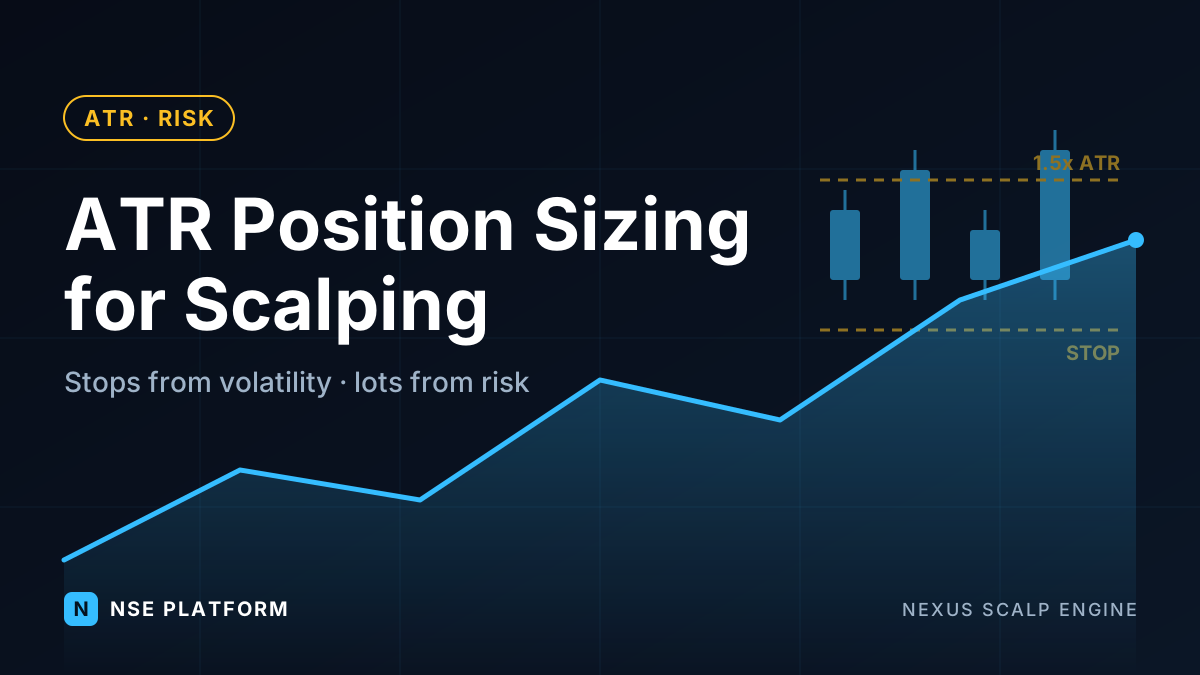
A fixed 10-pip stop is a guess. On a quiet Asian morning it sits far outside normal noise; on a London open after a US data release it sits inside one candle. ATR position sizing fixes that: the stop comes from how far the pair is actually moving right now, and the lot size comes from your dollar risk. Volatility changes the distance, never the amount you can lose.
The ranking guides show the ATR formula on daily charts with 60-pip stops, while scalpers live on M1 and M5 with 5–10 pip stops and spreads that eat the target. This guide sizes ATR for scalping specifically — M1/M5 settings, the spread-adjusted break-even table, and what to do when ATR itself breaks down.
ATR position sizing sets your stop from the Average True Range and your lot size from fixed dollar risk: stop distance equals ATR times a multiplier, and lot size equals dollar risk divided by stop distance times pip value. For scalping, use ATR(14) on M5 with a 1.5x multiplier and risk 0.25%–0.50% per trade.
Key takeaways
- ATR measures how far price moves per candle, not where it is going. Never use it for direction.
- Stop distance = ATR × multiplier. For scalping, 1.5x ATR on M5 is the starting point.
- Lot size = dollar risk ÷ (stop distance × pip value). When ATR widens, the lot shrinks and the dollar risk stays fixed.
- A 1-pip spread on a 5-pip M1 target takes 20% of the win. Check the break-even table before every session.
- ATR fails during news spikes and gaps: it lags the move, so black out high-impact releases instead of trusting the number.
What ATR is, in one minute
The Average True Range was developed by J. Welles Wilder in 1978, in the same book that introduced RSI. It measures the average size of price movement over a set number of candles. The "true range" of one candle is the largest of three numbers: high minus low, the absolute value of high minus previous close, and the absolute value of low minus previous close. Including the previous close is what lets true range capture gaps that a simple high-minus-low would miss.
ATR is the average of those true ranges over N periods. Wilder's original smoothing divides differently from a simple moving average, but on MetaTrader 5 the ATR indicator does the arithmetic for you — what matters is reading the number it prints. If ATR(14) on M5 EUR/USD reads 0.0005, the pair has been moving about 5 pips per 5-minute candle. That is a distance, not a direction: a falling market raises ATR exactly as fast as a rising one.
ATR is timeframe-dependent, and this is where scalpers go wrong first. A daily ATR on EUR/USD is roughly 50–80 pips; an M5 ATR is a few pips. Never use a 5-minute ATR to size a stop on a trade you hold for hours, and never use a daily ATR for a 3-minute scalp.
The ATR position sizing formula
Two formulas, used in order:
Step 1 — the stop. Stop distance = ATR × multiplier. The multiplier is your buffer against normal noise: 1.5x for scalping, 2x to 2.5x for day trading, 3x and above for swing trading. The5ers' ATR guide uses the same bands, and the reasoning is identical across sources: one ATR sits inside ordinary noise, so the stop needs a multiple of it to survive a normal pullback.
Step 2 — the size. Position size (lots) = dollar risk ÷ (stop distance in pips × pip value per lot). Dollar risk is your account × risk percentage. The division is the whole point: when ATR doubles, the stop doubles, and the formula halves the lot. Your worst case stays at the dollar risk you chose, whatever the market is doing.
Work it once by hand before trusting a calculator:
| Step | Input | Calculation | Result |
|---|---|---|---|
| Account | $5,000 | — | — |
| Risk per trade | 0.5% | $5,000 × 0.005 | $25 |
| M5 ATR(14) | 5 pips | — | — |
| Multiplier | 1.5x | 5 × 1.5 | 7.5-pip stop, round to 8 |
| Pip value | $10 per lot | — | — |
| Lot size | — | $25 ÷ (8 × $10) | 0.31 lots |
Round down: 0.31 lots, not 0.32.
ATR settings for scalping
There is no universal ATR setting, only a setting matched to your holding time. The table below combines the settings the ranking guides agree on with the scalping adjustment this guide adds: a fast period for fast charts.
| Style | ATR period | Multiplier | Why |
|---|---|---|---|
| Scalping (M1/M5) | 5–14 | 1.5x | Reacts fast; tight stop, small size |
| Day trading (M15/H1) | 7–14 | 1.5x–2x | Balanced default |
| Swing trading (H4/D1) | 14–21 | 2x–3x | Survives multi-day noise |
For scalping, start with ATR(14) on the M5 chart and 1.5x. If your stops are hit by ordinary noise — price taps the stop and immediately reverses in your direction — test ATR(20) or a 2x multiplier before changing anything else. If your stops are never hit and your targets feel unreachable, the multiplier is too wide for the timeframe, not too tight.
Two rules that prevent most ATR errors. First, read ATR in the same units as your stop: pips for EUR/USD, dollars for gold. On gold the indicator prints dollars per ounce, so a $4 ATR with a 1.5x multiplier is a $6 stop — do not convert it to pips, because gold brokers quote pips at $0.10 and $0.01 and the conversion is where sizing errors hide. Second, place the stop beyond structure first, then check it against ATR. If the nearest swing needs 12 pips of room and your 1.5x ATR stop gives 8, the trade needs a wider stop or no trade — never shrink the stop to fit the size you wanted.
The cost math first: spread versus ATR stops
A scalping stop is small, so the spread is a large share of it. The break-even win rate after costs is effective loss ÷ (effective win + effective loss), where "effective" means after subtracting the spread from the win and adding it to the loss. This table uses a 1.5R setup — an 8-pip stop and a 12-pip target — at three spread levels:
| Spread | Effective win | Effective loss | Break-even win rate |
|---|---|---|---|
| 0.5 pips | 11.5 pips | 8.5 pips | 42.5% |
| 1.0 pip | 11.0 pips | 9.0 pips | 45.0% |
| 2.0 pips | 10.0 pips | 10.0 pips | 50.0% |
At a 2-pip spread the same setup needs a coin flip just to break even, before slippage. And the stop distance matters as much as the spread: with a 5-pip stop and a 1-pip spread, the spread is 20% of the stop before the trade even starts. The practical rule is simple — if the spread is more than 15% of your ATR stop distance, either widen the target, wait for a better session, or skip the pair. This is the check the ranking guides leave out, and it is the one that decides whether a scalping system can work at your broker.
Worked example: EUR/USD and gold, labelled as example
Example — not live prices. The numbers below use stated assumptions so you can check the arithmetic. They are not market data.
EUR/USD, M5, London open. Account $5,000, risk 0.5% = $25. M5 ATR(14) reads 5 pips (example reading). Stop = 1.5 × 5 = 7.5, rounded to 8 pips. Target = 1.5 × stop = 12 pips. Lot size = $25 ÷ (8 × $10) = 0.31 lots, rounded down. If the spread is 0.8 pips, the effective win is 11.2 pips and the effective loss 8.8 pips, so the break-even win rate is 44%. The trade risks $25 to make $37.50 before costs.
XAUUSD, M5, same session. Account $5,000, risk 0.5% = $25. M5 ATR(14) reads $4.00 (example reading). Stop = 1.5 × $4.00 = $6.00. Target = 1.5 × stop = $9.00. One 0.01 lot of gold is 1 ounce, worth $1 per $1 move, so size = $25 ÷ $6.00 = 4.16 ounces = 0.04 lots, rounded down. If the gold spread is $0.30, it takes 5% of the $6 stop and 3.3% of the $9 target — acceptable. If the spread widens past $0.90, it takes 15% of the stop: stop trading gold until it normalises.
When ATR rises mid-session. Suppose the EUR/USD M5 ATR climbs from 5 to 9 pips after a data release. The stop becomes 1.5 × 9 = 13.5, rounded to 14 pips, and the lot becomes $25 ÷ (14 × $10) = 0.17 lots. Same $25 risk, smaller size, wider stop. The trader who keeps trading 0.31 lots with a 14-pip stop is now risking $43.40 per trade — 0.87% instead of 0.5% — without changing a single setting. That silent drift is what ATR sizing exists to prevent.
When NOT to trade ATR sizing
ATR is a lagging average of past ranges. It tells you how far price has been moving, not how far it is about to move, and that gap is dangerous in exactly three situations.
First, high-impact news. In the 30 minutes around CPI, NFP, or an FOMC decision, spreads widen and price can gap through any ATR stop. The ATR reading before the release reflects the quiet market, not the release. Close scalps 15 minutes before the release and do not re-enter until the spread is back inside its normal range. Gold is the worst case: after a hot US inflation print, spreads can spike several times their normal width in seconds.
Second, the first minutes of a session. ATR(14) on M1 needs 14 candles to mean anything; in the first minutes after the London open, the reading is still dominated by the quiet Asian session. Wait for the indicator to reflect the session you are actually trading, or use the M5 ATR, which settles faster in relative terms.
Third, after a volatility spike. ATR stays elevated after the move that caused it. A stop sized from post-spike ATR is wide and the lot is small — correct for the risk, but the target must widen too, or the trade's reward no longer justifies its risk. If the ATR stop is more than twice your usual stop, the session has changed character: reduce size further, widen targets, or stand down.
Five mistakes with fixes
Using ATR for direction. A rising ATR on a falling market looks like momentum; it is only speed. Fix: direction comes from structure, EMA, or VWAP. ATR only sizes the stop.
One ATR setting for every pair. GBP/JPY moves roughly three times as far per day as EUR/USD, and gold's dollar ATR cannot be compared with a pip ATR at all. Fix: read ATR per pair, per timeframe, per session. Compare volatility across pairs with ATR as a percentage of price, not in raw units.
Sizing from the stop you want, not the stop ATR gives. Picking 0.5 lots first and then fitting a 5-pip stop around it inverts the formula. Fix: ATR sets the stop, risk sets the dollars, the division sets the lot. In that order, every time.
Ignoring the spread in the break-even rate. A setup that wins 45% of trades at 1.5R looks profitable until a 2-pip spread pushes break-even to 50%. Fix: compute break-even after costs, and judge the setup on 50 logged demo trades against that number.
Letting one pair's risk stack. ATR sizing controls risk per trade, not risk across trades. Three open EUR/USD longs, a GBP/USD long, and a gold short can share the same dollar driver. Fix: cap total risk per theme — for example, 1.5% maximum across all USD-long trades — and cap risk per currency even across different pairs.
Frequently asked questions
What ATR period is best for scalping?
Start with ATR(14) on M5, or ATR(5) if you trade M1 and want a faster read. Test one setting for at least 50 trades before changing it; the period matters less than using the same one consistently and matching it to your holding time.
What multiplier should scalpers use?
1.5x ATR is the standard starting point for scalping. Use 2x if your stops are repeatedly hit by normal noise, and only after confirming the problem is the stop distance, not the entry. Wider than 2x on M1/M5 usually means the timeframe is too fast for the pair's volatility.
Does a high ATR mean I should trade bigger?
No — the opposite. A high ATR means wider stops, and wider stops mean smaller lots at the same dollar risk. ATR sizing keeps risk fixed; it never justifies more risk.
Can ATR replace a stop loss?
No. ATR sizes the stop; it does not place it, and it cannot protect you from gaps or spread blowouts. Always place the stop order with the entry, beyond the nearest swing, at the ATR distance.
Why does my position size keep changing?
Because ATR changes. That is the system working: the lot shrinks when volatility rises and grows when it falls, so the dollars at risk stay constant. If the size never changes, you are not actually using ATR sizing.
How is ATR position sizing different from fixed fractional sizing?
Fixed fractional sizing risks the same percentage with a fixed pip stop, so the dollars at risk swing with volatility. ATR sizing fixes the dollars and lets the stop and the lot move with volatility. Van Tharp's percent-volatility model, described in Trade Your Way to Financial Freedom, is the formal version of the same idea.
Related reading
- Forex Scalping for Beginners — the M5 system this sizing method plugs into.
- Best Indicators for Scalping — EMA, RSI, and VWAP settings for the direction ATR cannot give.
- XAUUSD Scalping Strategy — ATR stops in dollars on gold, with the London sweep setup.
Sources consulted
- ATR indicator in forex: stops, settings and sizing — The5ers
- ATR position sizing: master volatility in forex trading — FXNX
- Volatility-based position sizing: ATR forex risk model — Alpha EX Capital
Educational material only — not financial advice. Forex and gold trading with leverage can produce substantial losses. Backtest and demo-trade any setup before risking real capital.